Custom Application Development Services Explained
The most repeated advice about custom application development services is to ship faster. Pick the team with the shortest timeline, put AI in the loop, and count progress in story points burned per sprint. That advice is why so many custom builds arrive on schedule and then dissolve in production, where nobody owns the alerts, the dependency tree is a stranger to everyone, and a good share of the code came out of a model that left no record of why.
I'd rather judge a build by what happens on the worst day of its first year. Who detects the incident. How long a rollback takes. Whether the release that broke can be traced to a commit someone reviewed and a build someone tested. All of that is answerable before you sign, if you ask for evidence instead of a roadmap.
Table of Contents
- What Custom Application Development Services Cover
- Service Lifecycle Phases and Deliverables
- Measuring Delivery Performance and Build Security
- Governing AI Generated Code in Production
- Post Launch Operational Responsibility
- Evaluate Providers and Choose an Engagement Model
What Custom Application Development Services Cover
Custom application development services are the end-to-end work of designing, building, testing, deploying, and supporting software that fits one organization's workflows, not the feature list a vendor happened to ship. The deliverable is an application that matches how the business runs, plus the operating model that keeps it running after the launch announcement.
A complete engagement covers connected disciplines. When one goes missing, the buyer inherits the gap:
- Discovery and technical assessment. Existing systems, data, and code get read before anyone draws a screen, so estimates rest on evidence rather than optimism.
- UI/UX design and architecture. Prototypes, component decisions, and the deployment topology that the application will live inside.
- Frontend and backend engineering. The application itself, its APIs, integrations, and data model.
- QA and automated testing. Suites that run on every commit, not a manual pass the week before release.
- Cloud infrastructure and deployment. Environments, pipelines, secrets management, and the monitoring that makes production visible.
- MLOps. Where a model is part of the product, training pipelines, model versioning, and serving on the same footing as the rest of the stack.
- Support after launch. Patching, incident response, cost review, and the unglamorous maintenance that decides whether year two is cheap or expensive.
That breadth is why a provider who writes code quickly but can't show test coverage, release control, or incident ownership leaves the buyer carrying the risk. Our own coverage runs from UI/UX design through backend and frontend engineering and QA, alongside Cloud & Platform, AI & ML, and Product Development, because those pieces fail together when they're bought separately.
The market for this work is international. World Bank data show global exports of digitally delivered services reached roughly US$3.82 trillion in 2022, nearly four times their 2005 value and about 54% of total global services exports, per the World Bank digital services analysis. Demand is distributed and delivery crosses borders, so the shortlist in front of you properly includes teams you'll never share a time zone with.
Nontechnical stakeholders often build the first version themselves, and how Vision enables nontechnical builders is worth reading on what that path produces before engineers inherit it. A prototype that proves a workflow is useful. A prototype that becomes production code without review is a liability with a login page.
Speed without governance isn't a discount. It's a deferred cost that lands after launch, when the people who understood the shortcuts have moved to another account. Audit any proposal in this order: scope, lifecycle, the numbers, AI controls, who is on call, then the contract.
Service Lifecycle Phases and Deliverables
A proposal is only as good as the phases it covers and the artifacts each phase hands over. Use the table below as a scoring sheet, column by column, before anyone mentions price.
| Phase | Key Deliverables | Success Metrics | Client Responsibility |
|---|---|---|---|
| Discovery | Problem statement, technical assessment, AI and code audit | Scope clarity, risk register | Business context, access to existing systems |
| Design | UI/UX prototypes, architecture documents, threat models | Stakeholder approval, security sign-off | Feedback cycles, compliance requirements |
| Engineering | Working code, weekly staging demos, software bill of materials | Deployment frequency, change lead time | Repository access, timely code reviews |
| Testing | Automated test suites, penetration test reports, AI code review | Change failure rate, coverage thresholds | UAT participation, bug triage |
| Deployment | Production release, runbooks, monitoring setup | Recovery time, uptime SLA | Environment credentials, go-live approval |
| Ongoing support | Incident response, cost reviews, model retraining | MTTR, spend variance | Escalation contacts, budget alignment |
The client column is the one buyers skip, and it's where schedules slip. Unreviewed pull requests sitting for a week, credentials requested on go-live day, compliance requirements discovered during testing: each of those costs more than it would have in week one.
How to audit a proposal against the table
Discovery should stay lean. We keep it short on purpose, understanding the client's problems and priorities before designing the solution, because a six-week discovery that produces a ninety-page document is usually a way to bill for reading.
Then look at the rhythm of delivery. Every week of product development should end with a demo on a staging environment the client can open themselves. One clickable demo replaces most status reporting, because nobody argues with a broken checkout button on a screen they opened themselves.
Ownership is the third check. The client should own what gets built, with the repository, cloud, and app store accounts in the client's name from the start. If a provider insists on holding the infrastructure in their own tenancy, ask what your access looks like on the last day of the contract.
Practical rule: if a phase has no named deliverable and no number attached to it, that phase isn't in the engagement. It's in the sales deck.
Run every proposal against all four columns. A vendor that covers engineering but leaves testing and support vague is selling you the cheapest third of the work and invoicing you for the rest later.
Measuring Delivery Performance and Build Security
Four numbers tell you whether a delivery team is improving, and none of them is headcount. The DORA metrics guide defines them as deployment frequency, change lead time, change failure rate, and failed-deployment recovery time.
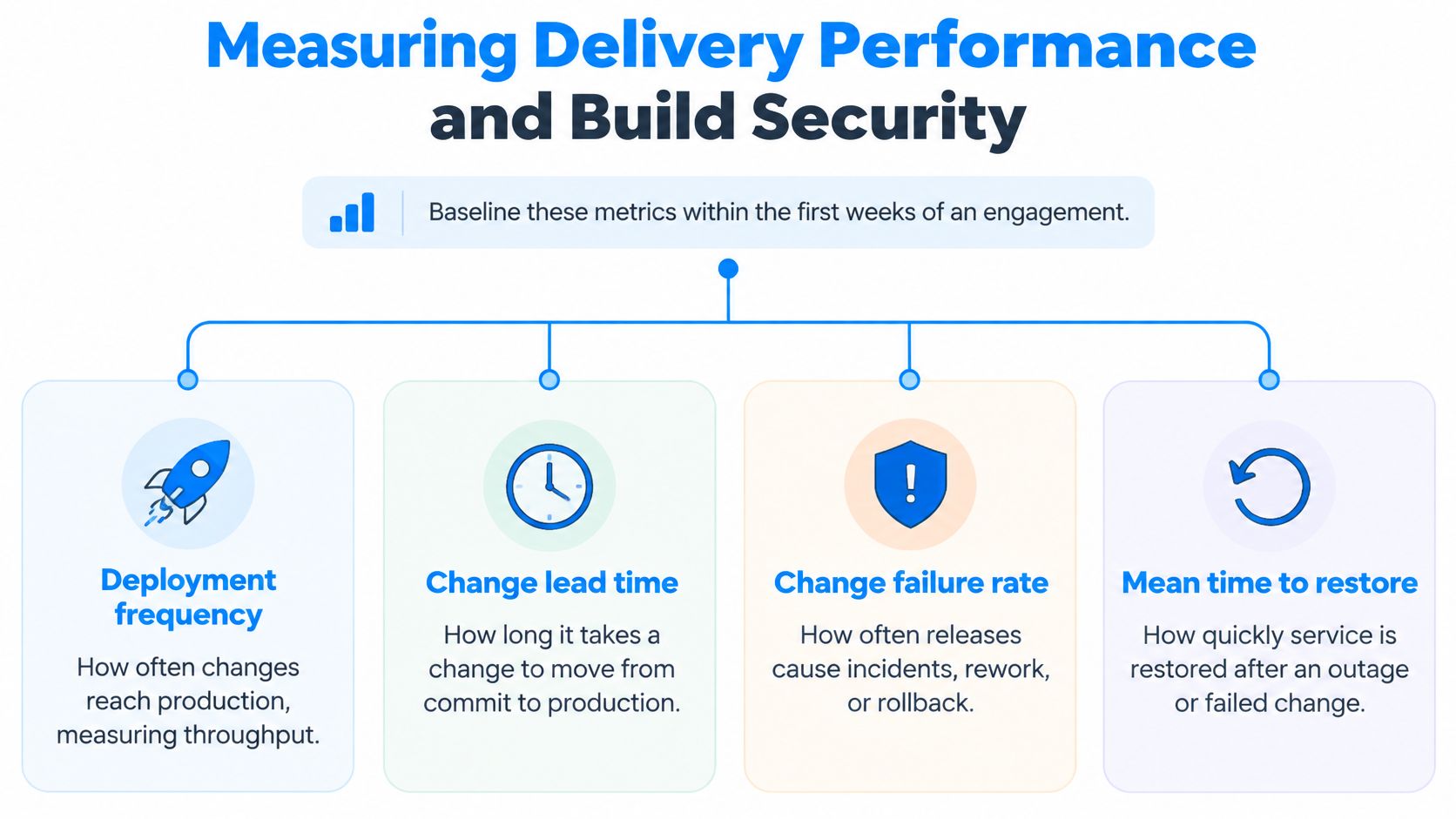
Deployment frequency indicates throughput. Change lead time measures elapsed time from commit to a successful production deployment. Change failure rate captures the share of deployments needing remediation, rollback, or a hotfix. Recovery time measures how fast service returns after a failed release.
The four form a control loop rather than a scoreboard. Smaller, independently deployable changes generally reduce release risk and shorten recovery, while automated testing, continuous integration, progressive delivery, and observability raise throughput without treating speed as a substitute for reliability. DORA's elite benchmark describes multiple deployments per day, change lead time under one hour, recovery under one hour, and a change-failure rate of 0 to 15%. For an augmented team, reporting these beats counting developers or story points, because it connects engineering activity to what production did.
What I'd ask for: a baseline taken over several weeks and split by product or team, before anyone promises an improvement.
Build security that produces evidence
NIST's Secure Software Development Framework recommends weaving secure practices into the existing SDLC rather than deferring them to a final penetration test, which reduces vulnerabilities, limits the impact of undetected weaknesses, and addresses root causes. The same guidance calls for testing executable code for flaws earlier reviews miss, collecting credible vulnerability reports from users and public sources, and reviewing code to confirm previously undetected issues.
Traceable artifacts make those controls auditable and repeatable: threat models from design, dependency inventories, code-review records, test results, build provenance, and vulnerability-remediation decisions.
The two halves connect. A release that can't be traced to a reviewed, tested build can't be trusted on the metrics either, because a fast recovery from a change nobody reviewed is luck, not capability.
Frameworks differ in emphasis and overhead, so compare secure development framework approaches before committing to one. Our Cloud & Platform Engineering work sits inside client teams on Kubernetes, CI/CD, and the infrastructure behind ML models and AI agents, which is exactly where these gates get enforced or bypassed. Treat security as continuous verification, and request the artifact list before you sign.
Governing AI Generated Code in Production
AI-assisted development is sold as free velocity. The stability data says otherwise. A 2025 Cloudsmith survey of 307 US and UK software professionals, reported by TechDay, found that 42% said at least half of their current codebase was AI-generated, only 34% used policy-enforcement tools designed for AI-generated artifacts, and 17% had no controls for AI-written code or dependencies. The same report cites Google DORA findings that a 25% increase in AI adoption was associated with a 1.5% decline in delivery throughput and a 7.2% decline in delivery stability.
That's the paradox worth internalizing. Generation gets faster while the system gets shakier, because unverified logic, license-incompatible snippets, and dependencies nobody chose enter the build through a side door. App Builder's 2025 survey of technology leaders found 98% reported low-code or no-code tools saved development time, with 78% saying those tools saved up to half of it, per App Builder's low-code and AI whitepaper. The time saving is real. What's missing from the pitch is the artifact trail.
The controls that belong in the contract
Governance here isn't a policy document, it's a set of gates that either run on every merge or don't run at all:
- AI-use disclosure. Engineers state where generated code entered, so review effort follows risk instead of being spread evenly.
- Provenance records. A merge links to a model, prompt context, or author, and to the human who took responsibility for it.
- Human review gates. No generated change reaches a protected branch without a named reviewer who can explain what it does.
- Software bills of materials. Every dependency listed, including the ones an assistant added on its own.
- Automated license and vulnerability scanning. Blocking, not advisory, with severity thresholds agreed in advance.
- Rollback ownership. A named person or role who reverts a bad release, written into the agreement.
For a buyer, the question to ask is blunt: what prevents an outsourced or augmented team from shipping unverifiable, vulnerable, or license-incompatible generated code into production? If the answer is a code of conduct, you have no answer. If you're inheriting an AI-built prototype or an existing codebase, we review it first and tell you what to keep and what to rebuild, which is cheaper than discovering the answer during your first incident. For teams weighing build-it-yourself options, this introduction to low-code and no-code AI sets out where those platforms fit and where governed engineering has to take over.
Post Launch Operational Responsibility
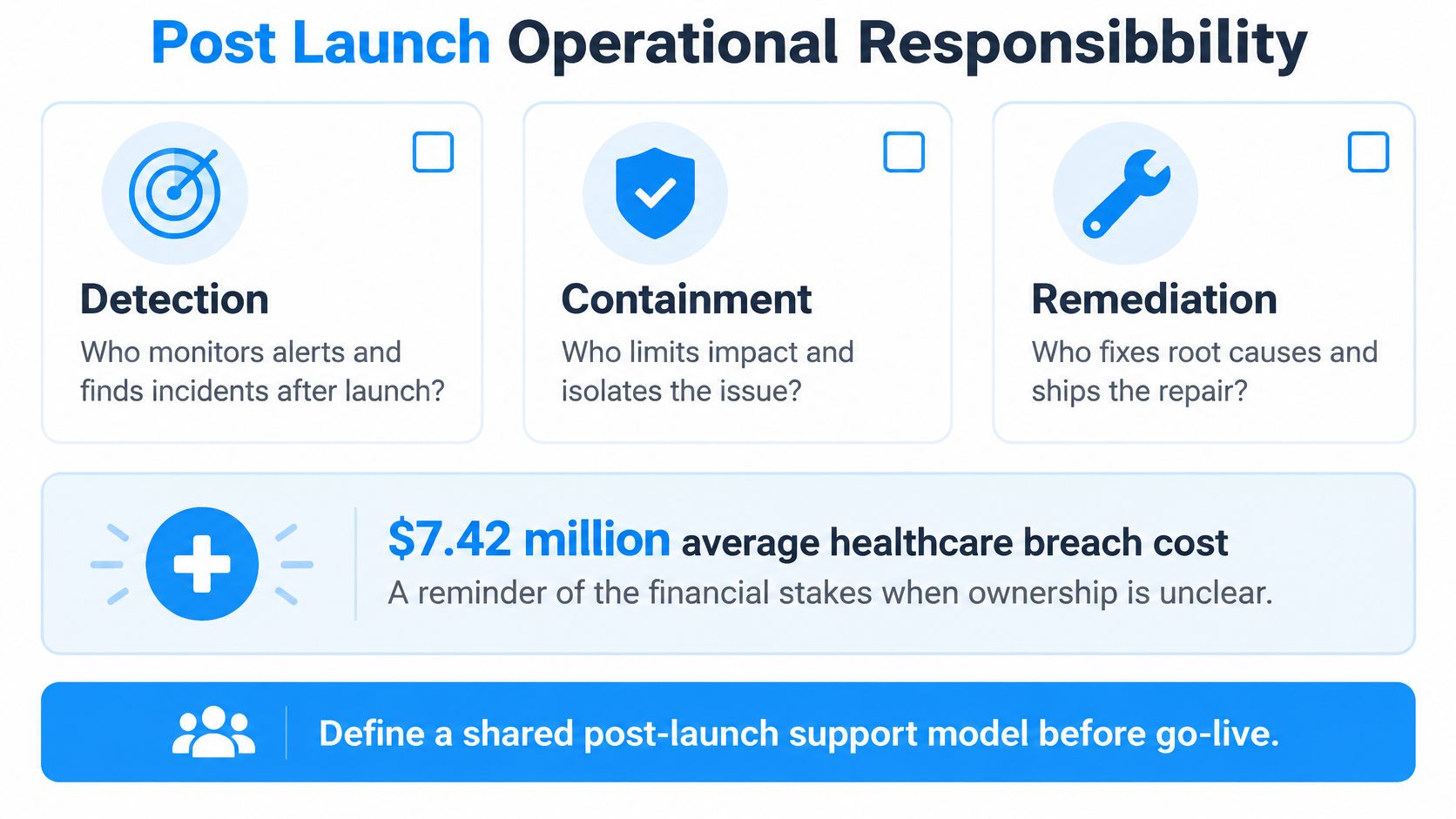
Launch is the moment risk changes hands, and it's exactly where contracts go quiet. Ask any custom development vendor who monitors alerts at 3am on a Sunday, who isolates a compromised service, who writes the regulator notification, and you'll often hear a version of "we can scope that separately."
The stakes aren't theoretical. The 2025 healthcare breach cost roundup reports an average of $7.42 million per healthcare breach, the highest of any industry, and cites 1,710 healthcare breach incidents reported to Verizon in 2024, including 1,542 confirmed data-disclosure cases. Those costs include detection and escalation, lost business, and post-breach response, not just fines.
Who owns what in the first 90 days
A shared-responsibility model works when each item has one accountable party, not two:
- Before build. Threat modeling and data minimization decisions, recorded so they can be tested later.
- Before go-live. Independent penetration testing and secure supply-chain controls across the pipeline.
- After go-live. Audit logging, a vulnerability-management SLA with stated response windows, and alert routing to people who can act.
- Under load. Disaster-recovery exercises run on a schedule, with results written down rather than assumed.
- During an incident. A breach playbook that has been exercised, including who speaks to regulators and when.
Compliance is not readiness. A signed risk assessment proves a document exists. It says nothing about whether anyone has contained a live incident under time pressure.
Observability stops being a dashboard and becomes an agreement. Monitoring, logging, and alerting should land in the client's team in a form they can act on, paired with regular reviews of cloud and model spend so cost doesn't drift unnoticed. Our global team provides 24/7 support for cloud infrastructure management, CI/CD, operations, and monitoring, and the same discipline applies to cloud and platform engineering that keeps releases repeatable in the first place.
For health-tech buyers, this operational layer is the key differentiator. Anyone can claim a compliant build. Ask for the date of the last disaster-recovery exercise and the last tabletop. A documented playbook that has never been run is a hypothesis, not a capability.
Evaluate Providers and Choose an Engagement Model
Three structures cover most engagements, and the right one depends on what you already have rather than on what a vendor prefers to sell.
Three ways to structure the work
Full project delivery puts scope, timeline, and milestones on the provider. It suits a defined problem with a clear product owner, and it exposes you to scope-creep arguments when the problem turns out to be different than expected.
Team augmentation embeds provider engineers in your standups, repositories, and review process. It fits teams that have direction but not capacity, and it fails when nobody on your side can review what comes back.
A hybrid starts from existing code or an AI-built prototype, stabilizes it, and moves it into governed production. That path is common now and it needs the most honesty, because part of the answer is often "rebuild this module."
A flexible provider adapts to your situation instead of steering every conversation toward one model.
Five questions with the evidence to demand
- Which DORA baselines will you report, and by which week? Evidence: a sample report from a current engagement with the segments you'll receive.
- How is AI-generated code disclosed, reviewed, and scanned before merge? Evidence: a sample disclosure record and the CI gate configuration.
- Which security artifacts ship with each release? Evidence: one real release bundle with threat model, SBOM, and test results.
- Who holds monitoring, incident response, and SLA obligations after launch? Evidence: the support agreement with response windows named.
- Who owns repositories, cloud accounts, and IP from day one? Evidence: account ownership in your name, not theirs.
Ask for the artifact, not the assurance. A vendor who has done this work can produce the file in an hour. One who hasn't will offer a slide.
Our engagement model is deliberately flexible: we work as an extension of your organization, integrate with your team for day-to-day operations, and run the weekly staging demo and code review rhythm inside your tools. If you want to pressure-test fit, request a demo or more information at hello@galliot.us. Weekly demos you can open yourself and a straight answer about what's broken are the minimum signals of maturity, and a guide on how to select a software engineering vendor covers the rest of the diligence.
Galliot builds custom applications end to end, from discovery and UI/UX design through backend, frontend, QA, cloud, and machine learning, and we stay with the systems after release to monitor, patch, and hand them over cleanly. If you're weighing a new build, a rescue of an AI-generated prototype, or extra engineering capacity inside your own team, we can walk through the lifecycle, the delivery metrics, and the engagement model that fits. Visit Galliot to start the conversation.
Produced via the Outrank tool
Get Started
Have a question? Send us a message and we will respond as soon as possible.
Leave us a comment