Continuous Delivery vs Continuous Integration Explained
The popular advice to automate everything and deploy more often skips the decision that matters: what evidence makes a change safe enough for production? A faster build doesn't answer that question, and a manual approval doesn't automatically mean your delivery process is immature. For healthcare applications, cloud platforms, and machine-learning services, the useful boundary is between generating trustworthy evidence and authorizing a release.
The names are often used loosely. When comparing continuous delivery vs continuous integration, focus on what developers and release owners can do with a validated change, not whether a dashboard says CI/CD.
Table of Contents
- Continuous Integration vs Continuous Delivery at a Glance
- How Continuous Integration Became the Foundation for Delivery
- How a Code Change Moves Through CI and CD
- DORA Benchmarks and Metrics for Each Practice
- Matching Each Practice to Your Team Situation
- Blind Spots That Make CI Look Like Delivery
- Choose Your Starting Point Between CI and CD
Continuous Integration vs Continuous Delivery at a Glance
Continuous integration (CI) checks whether a change merges and works safely with the shared codebase, while continuous delivery (CD) checks whether the validated result can be released reliably. CI gives developers engineering feedback; CD turns that feedback into a repeatable route to production.
CI and CD compared on the criteria that matter
| Dimension | Continuous Integration | Continuous Delivery |
|---|---|---|
| Core question | Does this change integrate safely? | Can the validated software be released reliably? |
| Trigger | Every commit or merge to the shared branch | Every change that passes automated validation |
| Main output | A built, tested and versioned artifact | An artifact promoted through staging toward production |
| Typical checks | Compilation, unit and integration tests, security scans | Packaging, deployment checks, environment provisioning, approval gates |
| Ends at | A green build on the shared branch | A change running in production or staged for release |
| Key metrics | Commit-to-green-build duration, queue time, test flakiness | Change lead time, deployment frequency, change-failure rate, recovery time |
| Human role | Developers fix broken builds | Release owners approve gates and trigger rollbacks |
These are stages of one pipeline, not competing tools. GitHub Actions, GitLab CI, or Jenkins can run both. Installing one of them doesn't establish either practice unless developers integrate frequently and the pipeline performs the required work.
Delivery is not deployment
Continuous deployment removes the manual production approval: every change that satisfies the automated release policy reaches production automatically. Continuous delivery can retain that approval while automating the preparation and deployment mechanics. AppJet's guide to continuous deployment for full-stack apps is useful when deciding whether that final transition suits an application spanning frontend and backend services.
A person clicking Approve is different from a person assembling a release, editing configuration, and running deployment commands. The former can be an intentional authorization boundary. The latter means the software still requires manual preparation.
Quick diagnostic: Could a merged, validated change reach production tonight through the existing pipeline?
If it proceeds automatically after all checks pass, you have continuous deployment. If it waits only for someone to authorize an otherwise automated release, you have continuous delivery. If someone must first prepare staging or construct the deployment by hand, you have integration automation, but haven't completed the delivery path.
How Continuous Integration Became the Foundation for Delivery
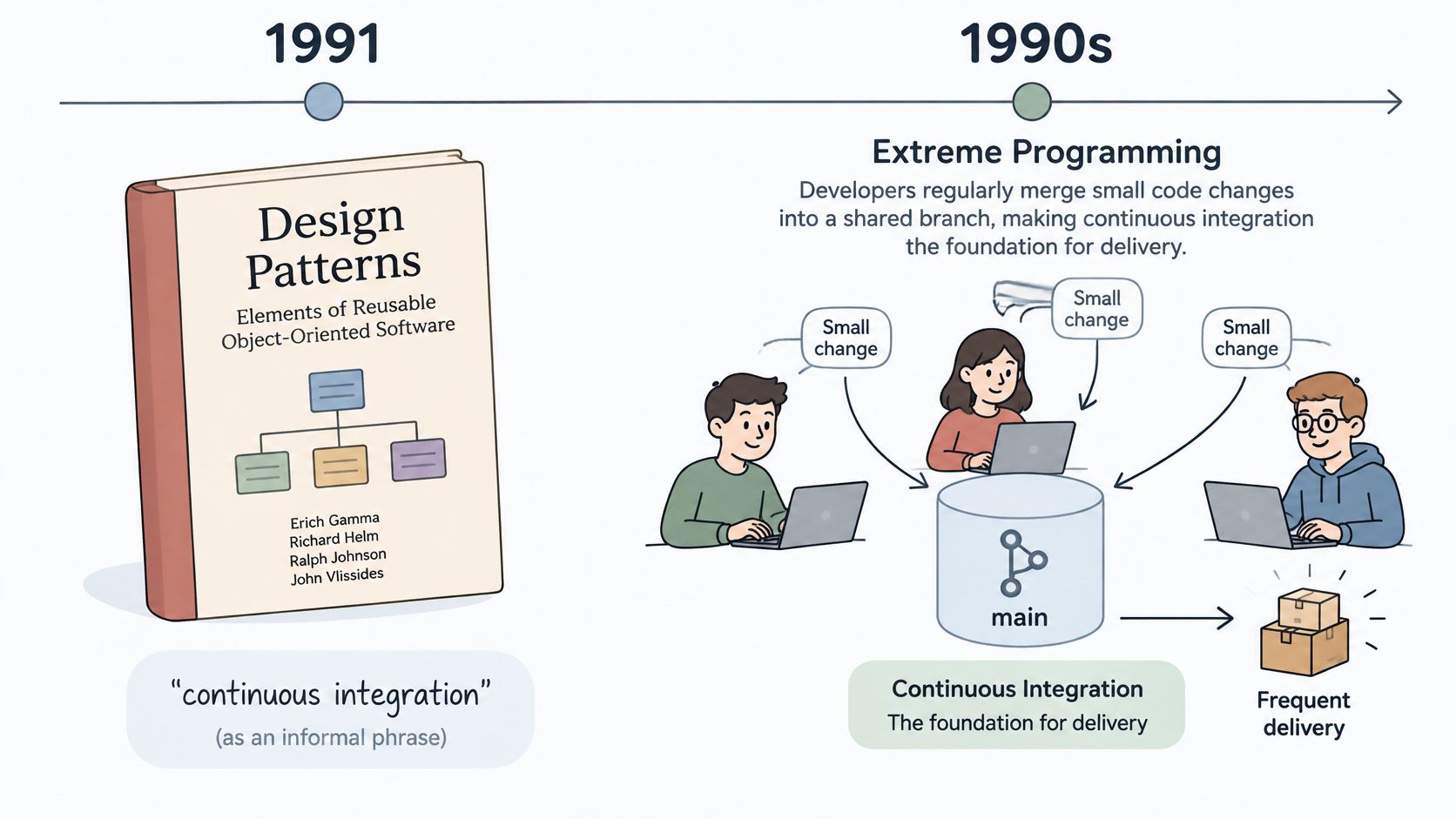
Grady Booch used the phrase continuous integration informally in his 1991 book on object-oriented design, and it became a central Extreme Programming practice during the 1990s; Martin Fowler's article helped consolidate the modern definition in 2000, with a later revision in 2006, as described in Usage, Costs, and Benefits of Continuous Integration in Open-Source Projects.
The important shift wasn't the vocabulary. Developers stopped treating integration as a separate event near release time and began merging changes frequently, then validating the combined code through automated builds and tests.
The dependency becomes clear at release time
Say a developer changes how an appointment service handles cancellations. CI builds the merged application and checks that the change works with scheduling, notifications, and persistence. Developers discover an incompatible interface while the change is still small, rather than during a release rehearsal.
But that successful build doesn't establish that the service will start with production configuration. It doesn't prepare infrastructure, verify deployment permissions, or establish that a database migration can run safely. Those responsibilities extend beyond integration.
Continuous delivery adds automated packaging, environment provisioning, deployment verification, and release processes. It builds on CI's feedback rather than replacing it with another set of tools.
A releasable artifact needs more than correct application code. It needs a repeatable way to run in its intended environment.
The distinction also explains why frequent merging alone isn't enough. A team can integrate throughout the working day while an operator still prepares each release from a checklist. Developers have reduced integration uncertainty, but release owners still carry operational uncertainty.
Human approval deserves separate treatment. An approval that authorizes an already prepared release can fit continuous delivery; an approval meeting that discovers unfinished deployment work cannot substitute for it. Judge the practice by the remaining work, not the pipeline's name.
How a Code Change Moves Through CI and CD
Consider a small API change that adds a validation rule to a patient-intake service. Keep its application code, tests, and configuration changes traceable together, then move the resulting artifact through a defined sequence.
Generate evidence before promotion
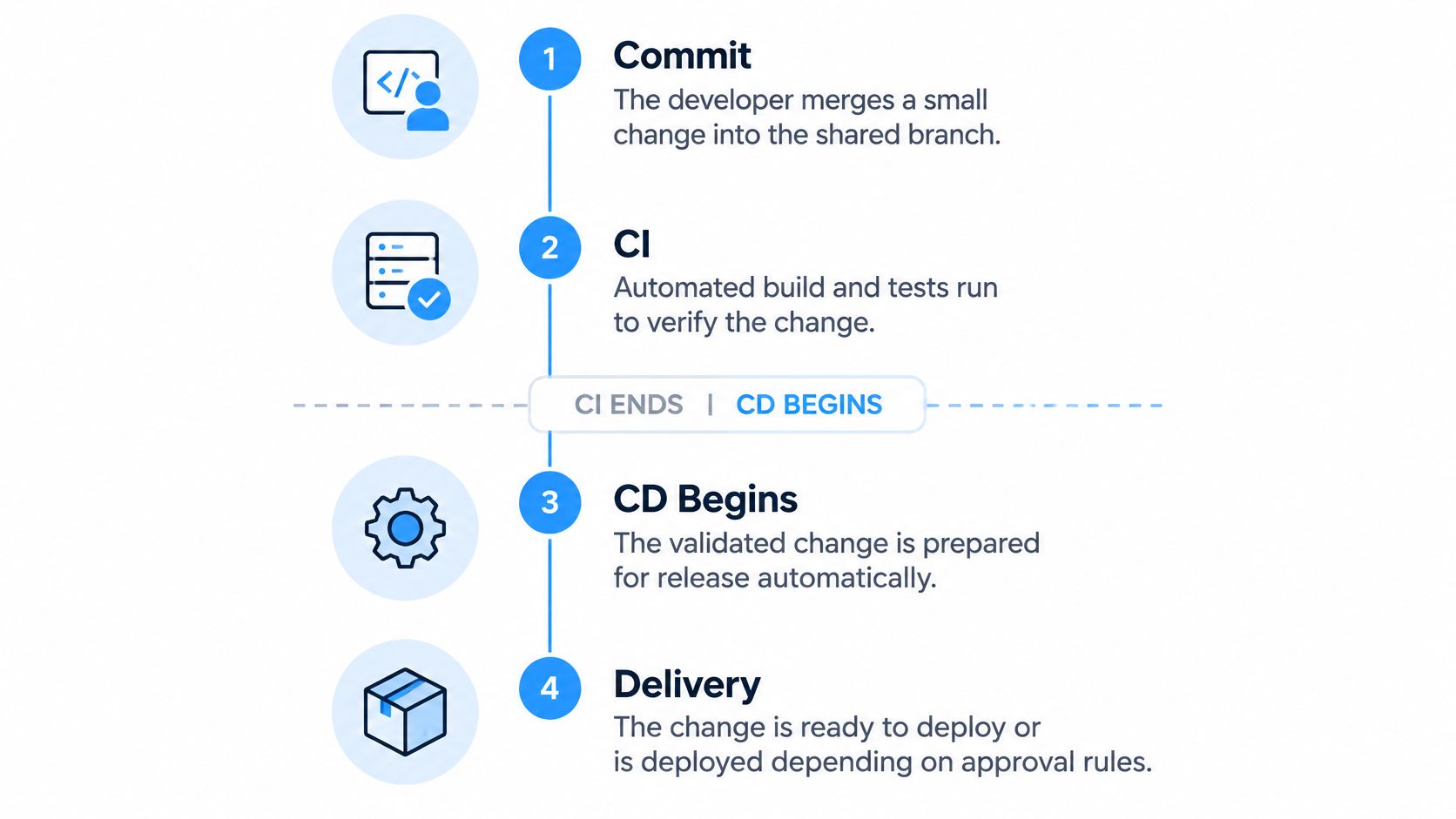
Commit to the shared branch. The developer merges the reviewed change, triggering validation against the current shared codebase. Checking only the feature branch can miss conflicts introduced by another merged change.
Compile and run unit tests. Put inexpensive, deterministic checks first so developers don't wait for a staging deployment to discover a basic failure. Slow feedback encourages developers to stack unrelated work on top of an unverified change.
Check integration, security, and dependencies. Test the API against its database and service contracts, then scan for vulnerable dependencies, exposed secrets, and unacceptable licenses. Flaky integration tests need an owner and a repair path, not unlimited retries until they pass.
Publish the immutable artifact. Store a versioned container image or package with its build ID, commit reference, and test results. CI stops here in this workflow; rebuilding later would break the connection between the tested artifact and the deployed artifact.
For a practical review of credentials, runner permissions, and artifact handling, DevArmor's guide to securing CI/CD pipelines step by step provides useful implementation context.
Authorize and observe the release
Prepare packaging and provision staging. CD begins by applying version-controlled deployment manifests and infrastructure definitions to the published artifact. Avoid recompiling application code during packaging, and keep environment-specific secrets outside the image.
Verify the staged deployment. Run smoke tests, exercise critical intake flows, and check configuration, connectivity, and migration behavior. A staging environment with materially different permissions or dependencies can give misleading results.
Evaluate the production gate. Attach the evidence to an approval or automated policy decision, including any migration and rollout constraints. Removing human approval creates continuous deployment only when automated policy checks still enforce the release requirements.
Deploy, monitor, and recover. Promote the same artifact, watch error rates and critical workflows, and stop or reverse an unhealthy rollout. A missing or incompatible rollback path can turn a recoverable release defect into a prolonged outage.
Automate compilation, validation, and artifact publication first. Those steps establish the evidence that later decisions need; the production gate is where human judgment may remain appropriate.
Assign these responsibilities during product engineering planning, rather than leaving deployment ownership until feature development ends. Application engineers should help define smoke tests and migration safety, while platform engineers make promotion and recovery repeatable.
DORA Benchmarks and Metrics for Each Practice
DORA benchmark ranges by performance tier
| Performance tier | Deployment frequency | Change lead time | Change-failure rate | Recovery time |
|---|---|---|---|---|
| Elite | Multiple times per day, on demand | Under one hour | 0–15% | Under one hour, using the ranges in Measuring Continuous Delivery |
| High | Between daily and weekly | One day to one week | 16–30% | Under one day, from the same benchmark ranges |
| Low | Fewer than once every six months in the benchmark described by IBM's DORA metrics guide | Not specified in the cited summary | Not specified in the cited summary | Not specified in the cited summary |
Treat these as benchmark ranges, not permanent thresholds. The table combines published tier descriptions for orientation; it isn't a single current-year distribution, and missing values shouldn't be estimated.
Benchmark editions also differ. The 2024 DORA report summary describes elite respondents as having change lead times below one day and a change-failure rate of about 5%. Use one benchmark edition consistently when setting organizational targets, rather than selecting whichever range makes a dashboard look strongest.
Separate feedback speed from delivery outcomes
CI metrics tell you how efficiently developers receive trustworthy feedback. Track commit-to-green-build duration, runner queue time, test flakiness, and the share of commits that produce deployable artifacts. A fast successful run can hide long queues and repeated failures, so measure the complete experience rather than only the final attempt.
CD metrics tell you what happens after that evidence exists. Track commit-to-production lead time, deployment frequency, change-failure rate, and recovery time. Start the lead-time clock at the version-control commit and stop it at successful production deployment, not when staging turns green.
That distinction changes the remedy. If validation is quick but production waits on release coordination, buying larger CI runners won't address the bottleneck. If developers spend their time rerunning unstable tests, removing a production approval won't improve the quality of feedback.
Instrument the actual constraints
Connect commit references, immutable build IDs, test-result metadata, deployment events, and rollback timestamps. Your DevOps monitoring approach should let an engineer follow a change across those events without reconstructing its history from chat messages.
For Kubernetes workloads, separate runner capacity, integration-test congestion, and GPU scheduling delays from deployment execution. Compare typical durations with tail durations, and record resource contention independently. Otherwise, an ML service waiting for accelerator capacity can look like a deployment-automation failure.
The operating target is frequent, small, reversible releases, not the highest possible deployment count. Review speed alongside failed promotions, production failures, and recovery effort. A shorter pipeline isn't an improvement if engineers spend the saved time repairing avoidable incidents.
Matching Each Practice to Your Team Situation
Continuous delivery is compatible with controlled release. A healthcare product can validate every change automatically while requiring explicit approval, audit evidence, and rollback readiness before production exposure. That's a deliberate risk decision, not necessarily an automation gap.
The more useful question is where work stops and what evidence permits it to continue. The Re-cinq discussion of DORA metrics reports that 43.5% of organizations take more than a week from commit to production, illustrating why teams should examine the whole delivery boundary rather than celebrate a green build alone.
Starting point by team situation
| Team situation | Start with | Add next | Release gate |
|---|---|---|---|
| Small team with few automated tests | CI on every merge | Broader test suite and flaky-test tracking | Manual release until tests are trusted |
| Team with reliable tests that deploys weekly | Automated promotion to staging | Automated production promotion | Approval for production only |
| Regulated healthcare product | CI on every change | Provenance, audit evidence and staged rollout | Human approval and rollback readiness before production |
| Machine-learning models served on Kubernetes | CI for code, data and model checks | Canary deploys for GPU and CPU services | Model evaluation and rollback checks before exposure |
| Mature team deploying many times a day | Continuous delivery with automatic promotion | Canary releases and automated rollback | Policy checks instead of manual approval |
Set the gate by consequence
For a small team, start with tests around customer-critical behavior rather than a broad but shallow suite. Keep manual release control while engineers learn which failures the pipeline reliably catches. Don't confuse a high test count with meaningful protection.
A team with trusted tests but manual releases should automate staging promotion before removing production approval. That exposes configuration and deployment problems without immediately increasing production exposure. Keep the approval focused on an explicit decision, not a second round of improvised testing.
Healthcare and life-sciences teams should attach evidence to the exact artifact being approved. Include relevant migration constraints, deployment provenance, verification results, and the recovery plan. Determine applicable approval requirements with the people responsible for the product's governance rather than assuming every service needs identical treatment.
For ML serving, assess the deployable combination of code, model, data assumptions, runtime, and hardware configuration. A canary on CPU infrastructure doesn't validate a GPU-specific execution path. Define acceptable behavior and resource use for each serving configuration.
Use risk tiers without creating bureaucracy
Classify changes by impact, reversibility, and exposure. An internal presentation change can follow a lighter policy than a patient-facing decision workflow or a destructive schema migration.
Use enterprise software delivery planning to assign owners to those policies and keep the rules reviewable. Mature teams can replace routine approvals with machine-enforced checks where the evidence is dependable.
Decision rule: Remove a manual gate when its decision can be expressed and enforced reliably, not because another team deploys more often.
A controlled release with tested recovery can demonstrate more operational maturity than rapid deployment with no credible way back.
Blind Spots That Make CI Look Like Delivery
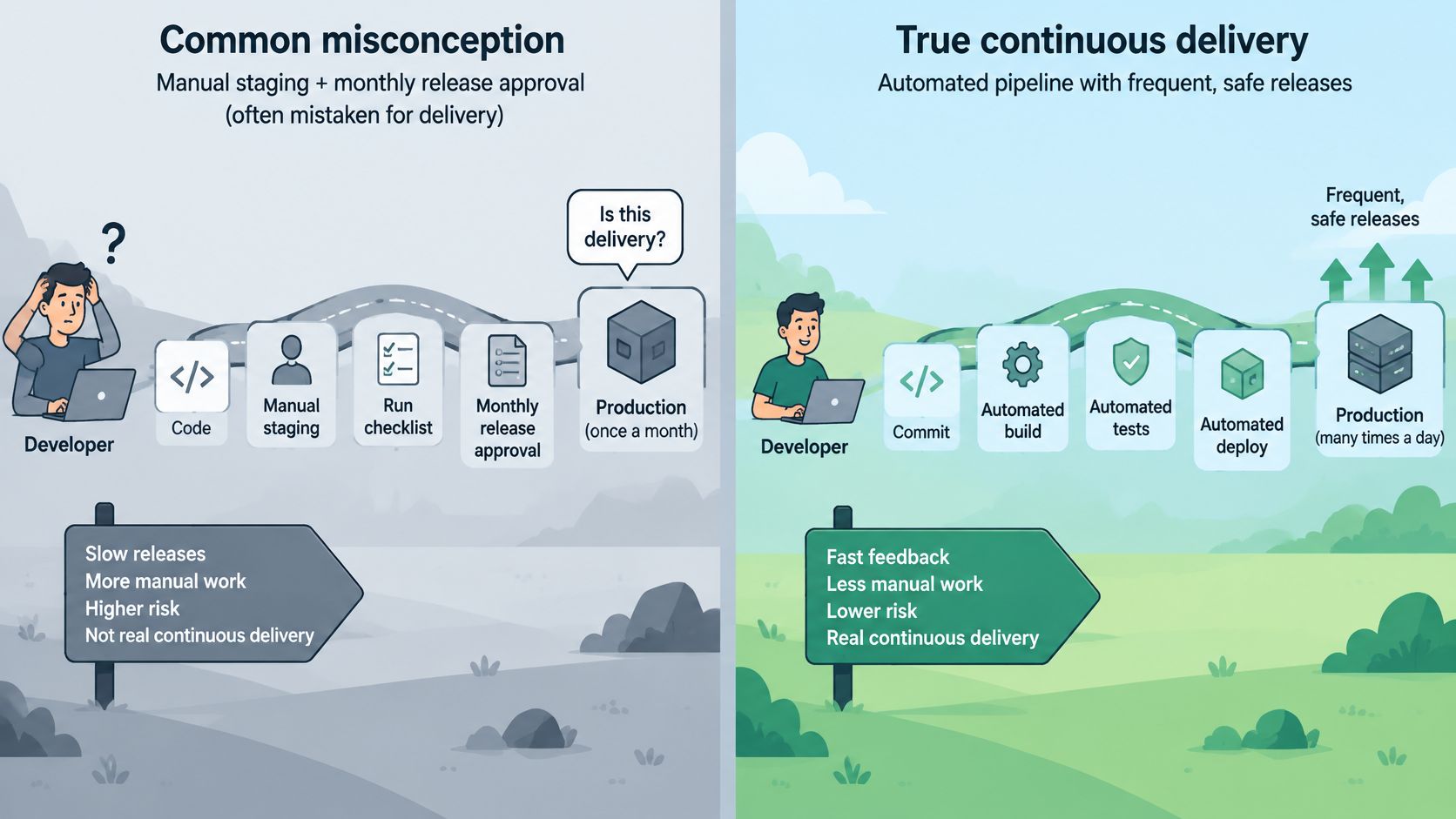
Frequent CI does not compensate for manual release assembly. Fix the gap by recording every action between a successful build and production, then automate the preparation work rather than renaming it. A scheduled approval is compatible with delivery only when the artifact remains ready to release.
Build duration does not measure customer delivery. Add commit-to-production lead time to the dashboard and retain timestamps for waiting, approval, and deployment. Otherwise, the team can optimize compilation while validated changes remain unused.
Repair trust before adding speed
Flaky tests are not harmless noise. Quarantine unstable tests with an owner and a repair condition, while preserving reliable coverage for the affected behavior. A quarantine must not become permission to ship a critical path without an effective check.
A successful deployment command is not proof of a healthy release. Add post-deployment smoke tests and rollout-stop conditions tied to service behavior. For stateful changes, test whether recovery requires a database restore, a forward fix, or an application rollback before authorizing production.
AI changes what the artifact must prove
AI-generated changes don't deserve a lighter gate. Code, tests, dependency updates, infrastructure manifests, and ML artifacts can share incorrect assumptions, so compilation and unit tests alone aren't sufficient. The paper on AI-enabled CI/CD security discusses safeguards including anomaly detection, threat modeling, and cryptographic provenance.
Require evidence appropriate to the artifact:
- Supply-chain checks: Verify dependency provenance, secrets exposure, licenses, vulnerabilities, and reproducible build inputs.
- Infrastructure checks: Validate manifests against policy and restrict the credentials available to build and deployment jobs.
- Model checks: Preserve model and data lineage, then run behavioral and safety evaluations against the intended serving configuration.
The distinction is evidence generation versus release authorization. CI should produce trustworthy evidence attached to an artifact; CD should evaluate whether that evidence satisfies the destination environment's policy. A human reviewer can interpret residual risk, but shouldn't be expected to reconstruct missing provenance or discover every unsupported assumption by reading a green status badge.
Choose Your Starting Point Between CI and CD
If your team doesn't have reliable automated tests, start with CI. If developers trust the tests but still assemble releases manually, automate promotion to staging next. If releases are already automated and observable, improve risk-based gates and recovery rather than pursuing speed as an isolated objective.
Choose the cheapest fix that removes a real constraint. That might mean repairing an unstable integration test, versioning a deployment manifest, or eliminating an approval that nobody understands. Replacing the entire toolchain should require stronger justification than inconsistent terminology.
Measure the gap before changing the pipeline
For a short baseline period, record both commit-to-green-build time and commit-to-production lead time for the same changes. Break the elapsed time into active work and waiting, and include unsuccessful attempts. Then select an improvement that addresses the largest controllable delay without weakening production safeguards.
Write down where your team considers CI complete. Name the artifact, the required checks, and the evidence retained with it. Separately document who or what authorizes production, what can stop a rollout, and which recovery procedures have been exercised.
For teams without in-house platform capacity, our Cloud & Platform Engineering service covers cloud platforms, Kubernetes, CI/CD, and infrastructure behind ML models and AI agents. Our senior engineers work inside the client's team, joining standups, using its repositories, and following its review process.
Scope is agreed per engagement. Cloud foundations can cover architecture, migration, Kubernetes, and infrastructure as code on AWS, Azure, or Google Cloud; hybrid and on-premises requirements are discussed case by case.
Make the next release easier to trust
Before the next release, complete a short operational checklist:
- Confirm pipeline stages: Identify the shared-branch validation endpoint and the artifact that moves beyond it.
- Set the production gate: Match required evidence and approval to the change's risk tier.
- Measure both lead times: Keep engineering feedback separate from successful production delivery.
- Document and exercise recovery: Name the rollback owner, prerequisites, commands, and verification steps.
You don't need to choose CI instead of CD. You need to establish a trustworthy integration foundation, then extend automation to the release boundary your team can safely control.
We help teams build CI/CD workflows, Kubernetes platforms, and the infrastructure behind production applications and ML services. Visit Galliot to discuss your current pipeline, identify where validated changes stall, and scope the promotion, monitoring, and rollback work needed to make releases dependable.
Get Started
Have a question? Send us a message and we will respond as soon as possible.
Leave us a comment