Enterprise Level Software Development: What It Takes
The most popular advice about enterprise software is to choose a scalable architecture, hire strong engineers, and automate deployment. That's incomplete. You can do all of those things and still ship slowly, expose sensitive data, and spend your senior engineers' time repairing changes that looked cheap to produce. Enterprise level software development is a measured delivery system, not a bigger application or a longer technology checklist.
Table of Contents
- What Makes Enterprise Software a Different Problem
- The Six Requirements at a Glance
- How to Measure Delivery Health with DORA Metrics
- Building Security and Governance into Delivery
- Measuring Whether AI-Assisted Development Pays Off
- Platform Engineering for Hybrid, Regulated and AI Workloads
- From a Health Tech Engagement to the First Step
What Makes Enterprise Software a Different Problem
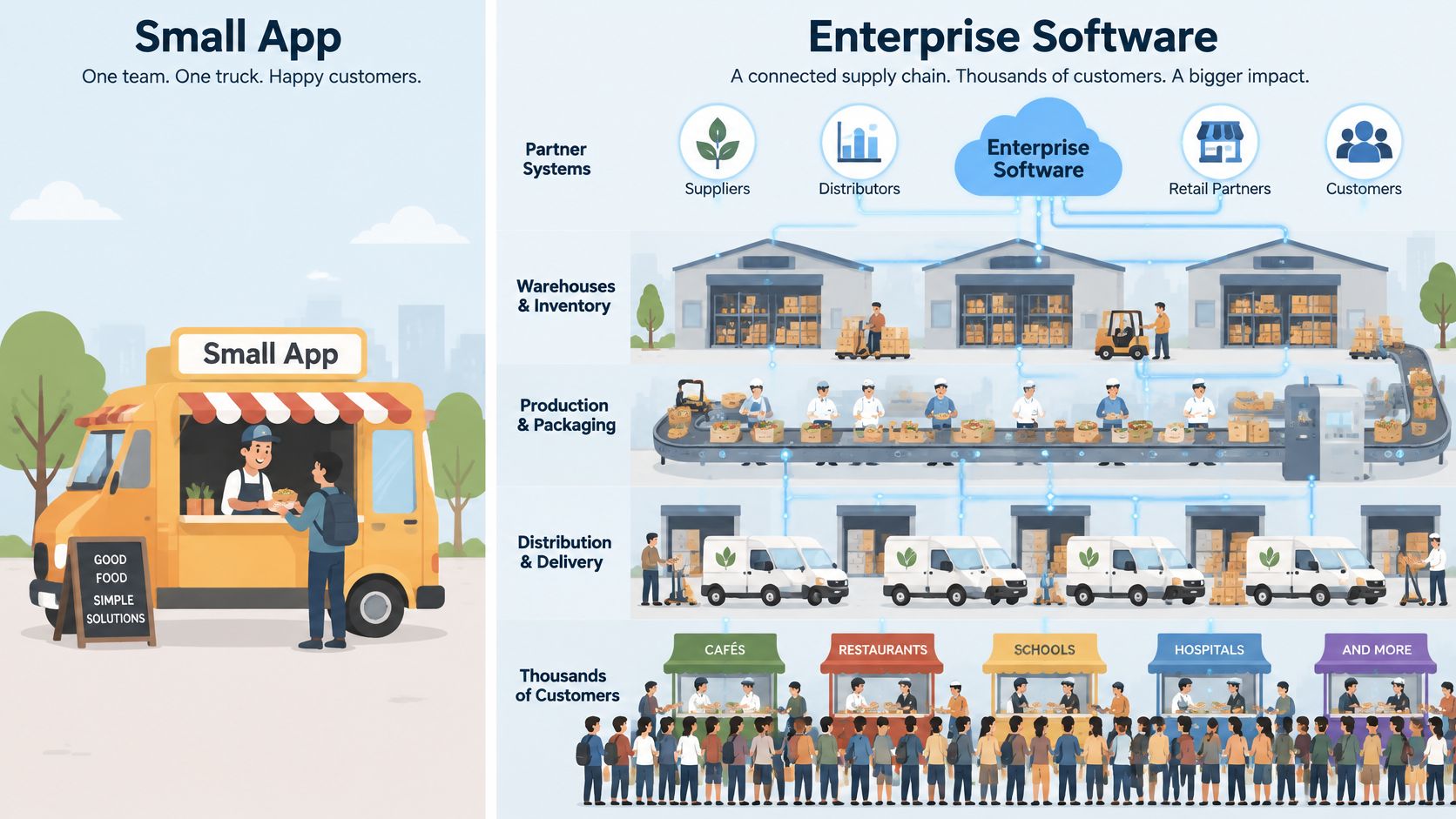
A small app works like a food truck: one team, a focused menu, and a manageable set of dependencies. Enterprise software is closer to a supply chain serving customers, auditors, and partner systems simultaneously. A broken connection can stop work far beyond the team that owns it.
Enterprise level software development means building systems that scale across users and regions, connect to existing platforms, protect sensitive information, control who may change what, and remain useful when components fail. Each of those demands has to be verifiable. A requirement nobody can measure is a hope, not a control.
The operating model matters as much as the architecture
The commercial stakes are substantial: McKinsey's Developer Velocity Index study found that top-quartile organizations achieved revenue growth four to five times faster than bottom-quartile organizations during 2014–2018, with tools, culture, product management, and talent management having the greatest effect on performance rather than coding output alone.
Treat that finding as a correlation. Leaders still have to connect engineering investment to customer needs and operating constraints, and tooling only pays off when the operating model around it works.
The pressures usually fall into these categories:
- Scale: Keep latency and resource consumption acceptable during peak demand.
- Integration: Preserve business workflows when partners or internal systems change.
- Security: Restrict access and prevent sensitive information from leaking.
- Governance: Make decisions, approvals, and production changes traceable.
- Reliability: Contain failures and restore service predictably.
Delivery practices carry those requirements into production. Load tests, API contracts, access policies, release evidence, and recovery exercises matter only when someone owns them and checks their results. Measurement makes the connection: a scale requirement becomes a load test result, a security requirement becomes a scan report and an access review, and a reliability requirement becomes a timed recovery exercise.
For organizing discovery through launch, Figr's guide to product development lifecycle stages provides useful planning context. Galliot's product engineering services cover UI/UX design, backend and front-end engineering, and QA across that lifecycle.
List which pressures your product already faces. That list should set your engineering priorities, rather than whether someone has labeled the application enterprise-ready.
The Six Requirements at a Glance
Use this enterprise requirements, benchmarks and warning signs table to assess observable behavior, not architecture diagrams.
| Requirement | Typical enterprise benchmark | Warning sign | Owning team |
|---|---|---|---|
| Scale | Load-tested peak capacity with explicit headroom and a regional expansion plan | Capacity planned only after an outage | Platform team |
| Integration | Connected systems use versioned APIs or governed adapters with contract tests | Point-to-point scripts between systems | Architecture team |
| Security | Role-based access, encryption in transit and at rest, dependency scanning in CI | Security review only before launch | Security team |
| Governance | Audit trail for every production change and approval gates for releases | Changes made directly in production | Engineering leadership |
| Reliability | Documented service availability and recovery targets, validated through recovery exercises | No defined target or no recovery test | Operations team |
| Delivery | Automated pipeline with documented deploy and rollback steps | Manual releases on fixed dates | Engineering teams |
Turn each requirement into evidence
Scale starts with a workload model. Test realistic request mixes, background jobs, database contention, and dependency limits. Adding application replicas won't fix an overloaded database connection pool. Regional expansion also requires decisions about data replication and consistency, not just another deployment.
For integration, require a supported contract around each connection. Legacy systems may need adapters rather than modern APIs, but the adapter still needs schema validation, timeout handling, and ownership. Consumer-driven contract tests can expose incompatible changes before either side deploys.
Security needs proof that the controls work. Test denied access as deliberately as successful access, and confirm that service accounts can't reach unrelated datasets. Encryption doesn't compensate for overly broad authorization.
Governance should preserve evidence without creating a manual approval queue for every harmless change. Protected branches, automated policy checks, and risk-based approvals can enforce rules while keeping routine work moving. Emergency access needs an explicit process and retrospective review.
Reliability targets should describe the customer's experience. A healthy server isn't useful if users can't complete a claims submission. Test restoration from backups and dependency failures, not merely whether a process restarts.
For delivery, use the same build artifact across environments and keep deployment instructions executable wherever possible. A calendar release isn't wrong on its own. The warning sign is needing undocumented human actions to make it succeed.
Practical rule: Mark a requirement as meeting only when the team can produce evidence. An intention, backlog ticket, or unused tool is partial at best.
Score each system meeting, partial, or missing. Prioritize missing controls by business impact and dependency exposure rather than treating every gap equally. An internal reporting tool and a patient-facing transaction service shouldn't receive identical availability targets, approval gates, or infrastructure budgets.
How to Measure Delivery Health with DORA Metrics
Increasing deployment frequency while production failures rise isn't a delivery improvement. Engineers may merge more changes while spending more time investigating incidents and undoing releases. Measure throughput and instability together.
The 2024 DORA report supports evaluating four linked measures: change lead time, deployment frequency, change failure rate, and failed-deployment recovery time. Use them as a diagnostic system, not a leaderboard for comparing unrelated teams.
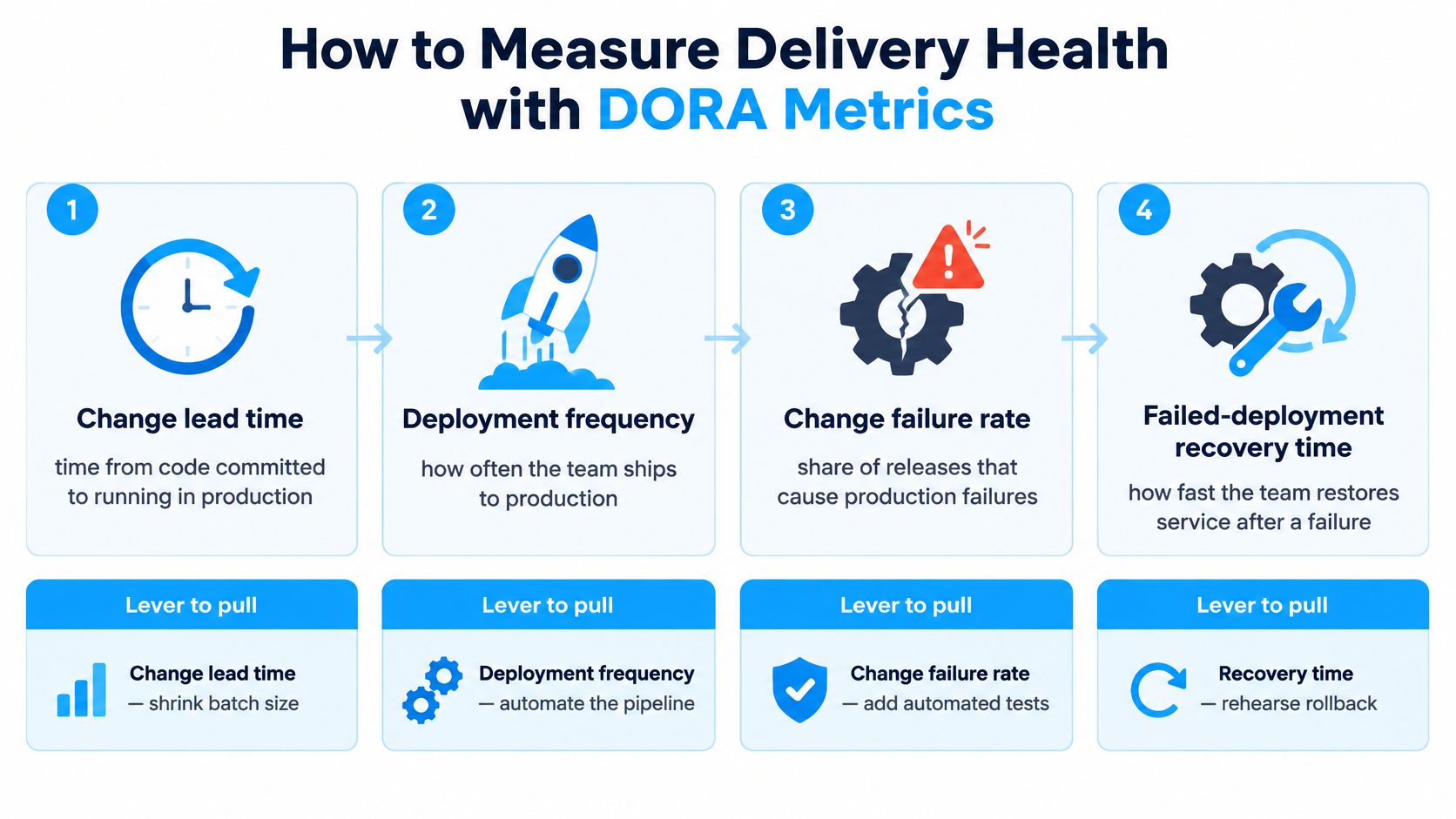
DORA delivery metrics and the lever to pull when each is weak
| Metric | What it measures | Lever when weak |
|---|---|---|
| Change lead time | Time from code commit to running in production | Smaller batches and fewer approval queues |
| Deployment frequency | How often changes reach production | Automated release pipeline |
| Change failure rate | Share of deployments that cause an incident or rollback | Stronger automated testing and progressive delivery |
| Failed-deployment recovery time | Time to restore service after a failed change | Observability, automated rollback and incident runbooks |
Instrument the service, not the individual
Choose a service or product boundary and define what counts as a production deployment. Record the commit, build artifact, deployment event, and related incident so the team can reconstruct the delivery path. Don't mix development-environment releases with customer-facing deployments.
Review the measures together during quarterly improvement cycles. Segment services with different operational constraints, and compare each team against its own baseline. A legacy application becoming safer to change is meaningful progress even if its release pattern differs from a cloud-native API.
Use parallel decision rules:
- High lead time: Shrink changes and remove waiting between implementation, review, and approval.
- Low deployment frequency: Automate packaging, environment configuration, and release execution.
- High failure rate: Strengthen tests and introduce canary releases or feature flags.
- Slow recovery: Improve diagnosis, rollback automation, and incident runbooks.
Investigate the actual bottleneck before buying another tool. If changes spend most of their time awaiting approval, faster builds won't materially shorten delivery. If database migrations prevent rollback, an application rollback button won't solve recovery.
Round-the-clock monitoring and operations support can shorten the interval between a failure and effective action, provided alerts reach someone with authority to respond. Our global team builds and provides 24/7 support for cloud infrastructure management, CI/CD, operations, and monitoring.
Choose the weakest measure and a specific lever to test this quarter. Keep the other measures visible so a local improvement doesn't create a larger operational problem.
Building Security and Governance into Delivery
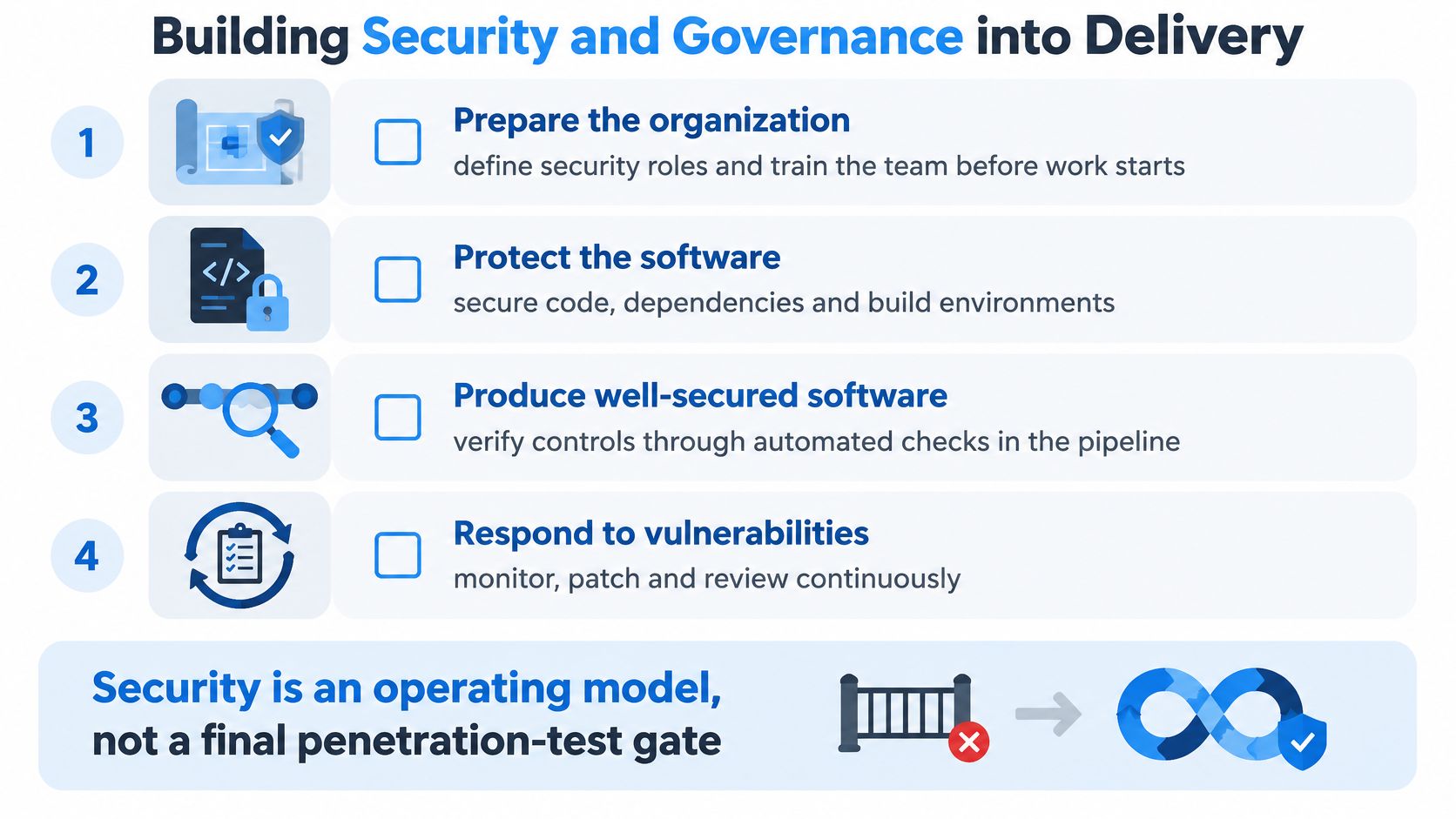
The NIST Secure Software Development Framework organizes secure development around four outcome-oriented groups: prepare the organization, protect the software, produce well-secured software, and respond to vulnerabilities. Treat those outcomes as ongoing responsibilities, not documents assembled before an audit.
Preparation establishes requirements and accountability. Protecting source code and build systems reduces opportunities for tampering; verification checks what engineers produce; vulnerability response handles weaknesses that escape prevention. A penetration test can contribute evidence, but it can't replace that operating model.
Make controls part of normal engineering work
Write testable security requirements. Put authorization boundaries, sensitive-data handling, and logging restrictions into architecture reviews and backlog acceptance criteria. For a healthcare application, specify which roles can retrieve patient records and which actions must appear in the audit log. Avoid acceptance criteria that merely say the feature must be secure.
Protect the build and its outputs. Require signed, access-controlled artifacts and restrict who can alter pipeline configuration. Promote the verified artifact instead of rebuilding an untracked variant for production. Keep secrets out of repositories and inject them through an approved secrets manager.
Scan changes inside CI. Check dependencies and infrastructure definitions alongside application code. Configure explicit rules for blocking releases and time-limited exceptions with named owners. A scanner that produces an ignored report doesn't provide an effective release control.
Connect incidents to engineering standards. Record how a vulnerability entered the system, how engineers detected it, and what prevented or delayed remediation. Feed recurring causes into templates, tests, and review checklists. Closing the incident ticket isn't enough if the same weakness remains easy to introduce.
Separate accountability from bureaucracy
Governance gives each control a named owner and an inspectable record. For sensitive changes, separate implementation from production approval while allowing automated checks to handle repeatable verification.
Emergency production changes need identity, justification, and a durable record. Don't normalize direct edits because the normal pipeline is inconvenient. Fix the pipeline and preserve an emergency route that remains accountable.
AI introduces additional decisions about permitted inputs, generated outputs, and human responsibility. Use Ekipa's responsible AI guidance as a discussion resource when defining that responsibility, then translate decisions into enforceable repository and workflow rules.
For healthcare teams, these practices are an engineering baseline, not a claim of regulatory compliance. Map each framework group to an owner and a control you can verify this month, including the evidence you would show a customer or auditor.
Measuring Whether AI-Assisted Development Pays Off
Faster coding is real, but it isn't the same as cheaper delivery. In McKinsey's 2023 generative-AI developer study, developers completed some coding tasks up to twice as fast, while time savings for highly complex tasks fell below 10%. Task complexity changes the result.
Downstream work deserves equal attention: the State of Platform Engineering report describes senior-engineer rework time increasing at 86% of organizations during the prior 12 months. That doesn't establish that every AI tool causes rework, but it makes reviewer capacity a necessary part of the business case.
Count the whole delivery cost
Suppose an engineer generates an integration quickly, but the reviewer must repair authorization checks, replace invented API calls, and add missing failure handling. The typing cost fell. The organization hasn't necessarily saved effort.
Measure cost per accepted, reliable change, including tool usage, implementation, review, testing, remediation, and operation. Keep task type and service criticality visible so a favorable mix of simple work doesn't conceal poor results on difficult changes.
For workflow design, SpecStory's meeting-to-ship AI guide is a useful companion to defining how requirements reach implementation. The governance question remains yours: what evidence must accompany a generated change before someone approves it? Align that decision with business and data science priorities rather than treating tool adoption as the outcome.
A generated change is valuable when the team can understand, verify, operate, and modify it. Acceptance by the compiler is only an intermediate check.
Use permissive experimentation for low-risk, isolated automation, with tests and no production secrets. Customer-facing and regulated services need stronger human review, traceability, and explicit ownership. Don't let an AI tool bypass the controls required for equivalent human-written code.
Establish the baseline before rollout
Record review effort, rework, and escaped defects before expanding access. Compare similar work and note changes in staffing, architecture, or release policy that could affect the result. Retain the ability to narrow usage when quality or reviewer load deteriorates.
What to track for AI-assisted development
| Measure | Why it matters | Segment by |
|---|---|---|
| Review hours per change | Shows whether faster code adds reviewer load | System criticality |
| Rework rate on AI-generated code | Share of generated code later rewritten | Team and service |
| Escaped defects and rollbacks | Shows quality after release, not just at merge | Criticality tier |
| Senior-engineer rework time | Shows whether experienced engineers absorb the cost | Team and seniority |
| Infrastructure spend per workload | Shows whether generated services cost more to run | Environment |
| Maintainability and technical debt | Shows whether changes stay easy to modify | Service |
Platform Engineering for Hybrid, Regulated and AI Workloads
Platform engineering needs an accountable owner, not just a catalog of infrastructure templates. The Stack Overflow developer survey highlights the importance of examining developer experience alongside technical adoption. A platform team's responsibility should be explicit: which developer journeys it supports, which controls it enforces, and which operational outcomes it owns.
More self-service isn't automatically better. A portal that lets developers create services without clear cost, security, or support boundaries can increase the organization's maintenance burden. Excessive abstraction can also hide the details engineers need during an incident.
Define platform products through user journeys
Start with concrete tasks: deploy a service reproducibly, retrieve a secret safely, promote an approved model, investigate a failed request, or restore a workload. Each task needs a supported path, an owner, and observable success criteria.
A portable MLOps platform illustrates the trade-off. Our ML platforms include training pipelines and model serving on GPU and CPU, experiment tracking, model versioning, and automated deployment that run the same way on any cloud or on-premises. That consistency helps teams standardize model promotion, but it doesn't eliminate differences in hardware capacity, networking, storage, or accelerator availability.
Use common interfaces where portability serves a real requirement. Choose cloud-specific managed services when their operational benefits outweigh migration constraints. Don't promise portability merely because workloads run in Kubernetes.
Our cloud and platform engineering offering addresses these infrastructure decisions. Cloud foundations cover architecture, migration, Kubernetes, CI/CD, and infrastructure as code on AWS, Azure, Google Cloud, or a hybrid with on-premises hardware.
For healthcare workloads, placement decisions must account for data residency, access controls, uptime, and model governance. GPU scheduling should respect dataset access boundaries, and promotion records should identify the model version and approved deployment environment.
Judge the platform by outcomes
Platform scorecard for enterprise platform teams
| Scorecard metric | What it shows | Healthy direction |
|---|---|---|
| Adoption | Share of teams building on the platform | Rising |
| Time to first production deployment | Onboarding speed for a new service | Falling |
| Paved-road usage | Share of teams using the standard paths | Rising |
| Policy exceptions | Requests to bypass platform controls, with reasons logged | Falling |
| Platform incident rate | Outages caused by the platform itself | Falling |
| Cloud spend per workload | Cost efficiency across environments | Stable or falling |
| Developer satisfaction | How teams rate using the platform | Rising |
Read the measures together. Falling exception requests can mean better defaults, or developers may have stopped asking and built around the platform. Pair telemetry with developer interviews.
Assign a platform owner and select a small set of outcomes from the scorecard. Make those outcomes part of the platform backlog, not a separate reporting exercise.
From a Health Tech Engagement to the First Step
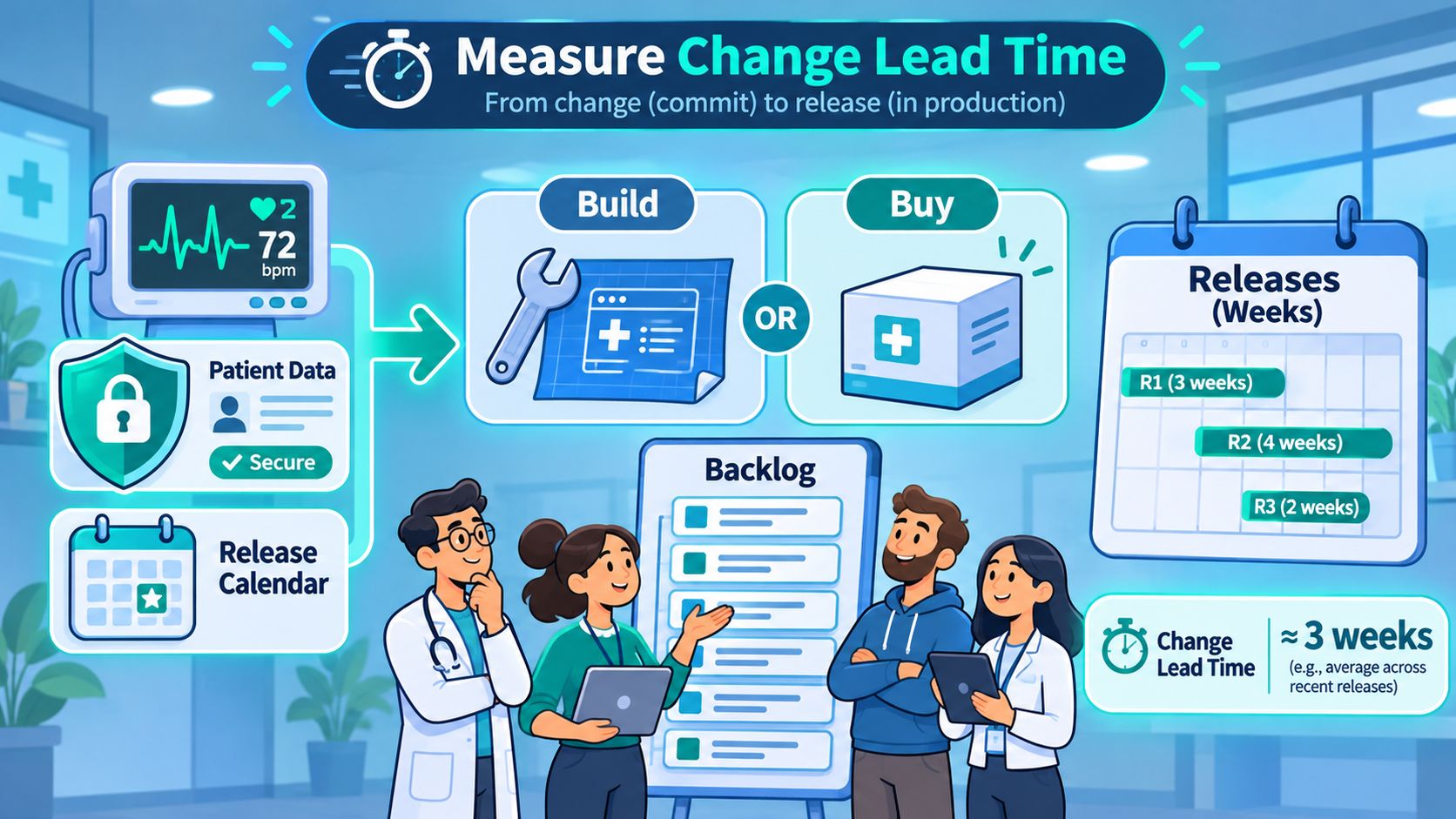
A health-tech team whose releases take weeks, whose customers discover production defects, and whose backlog exceeds its capacity faces a predictable temptation: add developers and roll out AI coding tools. Neither move addresses the constraint until the team learns where changes wait and why they fail.
A practical opening engagement produces three things: a delivery baseline, a prioritized risk register, and one working improvement already in production. An architecture presentation nobody can execute leaves the constraint exactly where it started.
Sequence the work around the constraint
Start by tracing one real change from commit to production and connecting it to release and incident records. That trace shows where work queues: a review step where pull requests sit for days, a manual regression suite that runs only before release, an approval gate that adds delay and catches nothing. Pick the weakest delivery measure and test a targeted fix before funding any broader program.
Next, score the application and its dependencies against the enterprise requirements. A claims workflow with weak authorization evidence and an untested restore procedure needs attention before a cosmetic platform migration. Convert the most consequential gaps into acceptance criteria with named owners.
Then move the relevant controls into the delivery path. Introduce AI assistance only where the team can measure its effect: hold a baseline of review hours, rework, and escaped defects, and compare after adoption. If generated changes overwhelm reviewers, narrow the permitted tasks. If rework doubles, throughput fell regardless of commit count.
- Keep ownership internal: Assign an employee who can accept the work and maintain the resulting decisions.
- Require executable handover: Store pipelines, runbooks, and infrastructure definitions in the repositories the team already uses.
- Demonstrate operational behavior: Show a deployment, a failure response, and the evidence each produces.
Choose capacity or a bounded outcome
Build in-house when the team has the expertise and can protect time for the work. Add outside capacity when delivery requires skills or attention the existing team cannot supply without dropping committed product work.
Galliot's engineers join client standups, work in client repositories, and follow the client's review process. The engagement model flexes to the constraint: Galliot can work as an extension of the client's organization, integrate with its team for day-to-day operations, or deliver a well-scoped project only. Its engineers are based in Europe and South America, which gives real working-day overlap with US and European clients, and each week of product development ends with a demo on a staging environment the client can open themselves.
Galliot's team designed the architecture of its ML operations platform and managed deployments and services for healthcare customers. That pairing matters for a scoped engagement: the team that ships the change also proves it against the infrastructure that runs it.
Client-reported outcomes provide context, not guarantees. The CTO at Chromex reported that migrating and renewing the stack reduced costs by 30%, improved security, and accelerated releases. Behzad reported faster identification of production issues and greater stability through infrastructure automation. Results depend on starting conditions and scope.
Whether you hire anyone or not, use the assessment to define the next deliverable: a measurable improvement, an enforced control, and an accountable owner.
Galliot's listed services are product engineering, cloud and platform engineering, and AI and ML, connecting software delivery to production operations. Visit Galliot to discuss your delivery bottleneck, the controls your systems need, and a scoped improvement your team can measure.
Get Started
Have a question? Send us a message and we will respond as soon as possible.
Leave us a comment