Cloud Computing Roadmap: A Step-by-Step Plan for 2026
“Migrate everything to the cloud” is poor architecture advice. It chooses the destination before anyone has checked workload economics, data constraints, or whether the team can operate what it's about to build.
A useful cloud computing roadmap starts with a different question: where should each workload run, and what happens when that environment becomes unavailable? Public cloud is one answer. Private infrastructure, colocation, edge deployment, and selective repatriation deserve the same practical assessment.
Table of Contents
- Cloud Computing Roadmap at a Glance
- Assess Readiness Before Choosing a Destination
- Decide Where Each Workload Belongs
- Stand Up the Platform Before the First Wave
- How to Sequence Migration in Waves
- Build Resilience and Sovereignty Into the Plan
- Control Spend Once Workloads Are Running
- Choose Your First Milestone and Owner
Cloud Computing Roadmap at a Glance
| Stage | Question it answers | Artifact to show |
|---|---|---|
| Readiness assessment | Where do we start, and what is blocking us? | Application and dependency inventory with a ranked gap list |
| Workload placement | Which environment fits each workload? | Placement decision for every workload, with its reason |
| Migration waves | What moves first, and how do we cut over? | Wave plan with pilot, cutover and rollback runbooks |
| Platform and automation | Can we deploy and recover without manual steps? | Infrastructure as code, CI/CD pipeline and monitoring alerts |
| Resilience and sovereignty | What fails if a provider, region or model becomes unavailable? | Dependency map with tested recovery time and recovery point targets |
| Cost and optimization | Who owns each dollar of spend, and what is idle? | Tagged budgets, a regular spend review and an owner for each cost line |
Treat these as acceptance criteria, not departments that hand tickets to each other. A stage isn't complete because someone presented a slide deck. The team should be able to open its artifact, explain the decisions, and demonstrate the operational result.
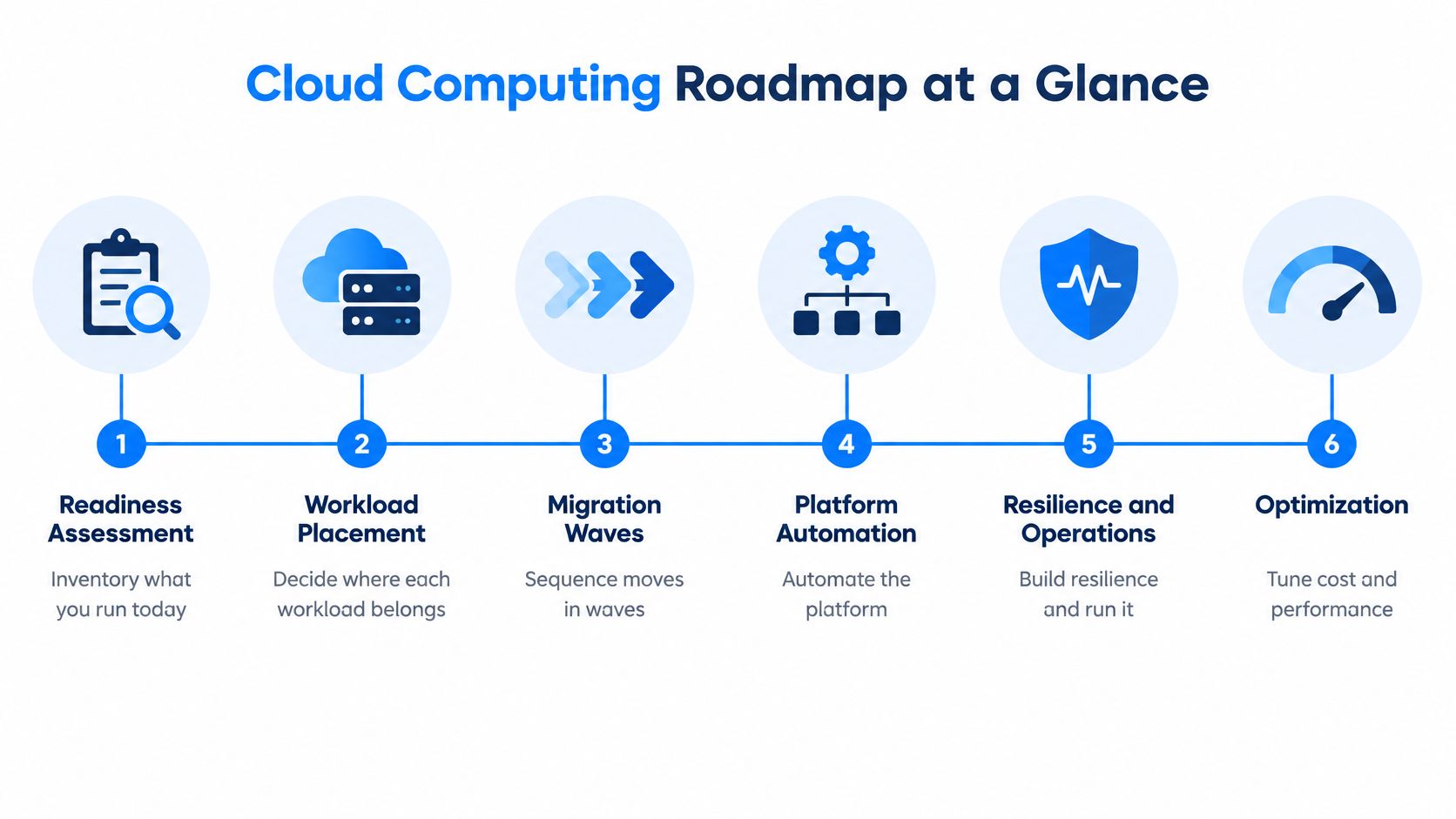
Work in overlapping tracks
Placement starts during discovery, when engineers uncover licensing restrictions or a database that can't tolerate additional network latency. Security controls belong in the platform foundation. Cost tagging must reach the first migration wave, rather than becoming cleanup work after an unexpectedly large bill.
Some activities also happen out of diagram order. Build the reusable platform before moving production traffic, even while the team is still planning later migration waves. Begin recovery design while choosing services, because recoverability can change which service is acceptable.
Synergy Research Group estimated worldwide cloud infrastructure-service revenue at $419 billion for 2025. That infrastructure scope includes IaaS, PaaS, and hosted private cloud, not the entire cloud software and consulting ecosystem.
For an engineering team, the practical implication is broader planning: include data platforms, machine learning infrastructure, operational automation, and financial ownership, not just server relocation. If you don't have an application inventory, start with readiness. Buying a destination before documenting the starting point only makes the unknowns more expensive.
Assess Readiness Before Choosing a Destination
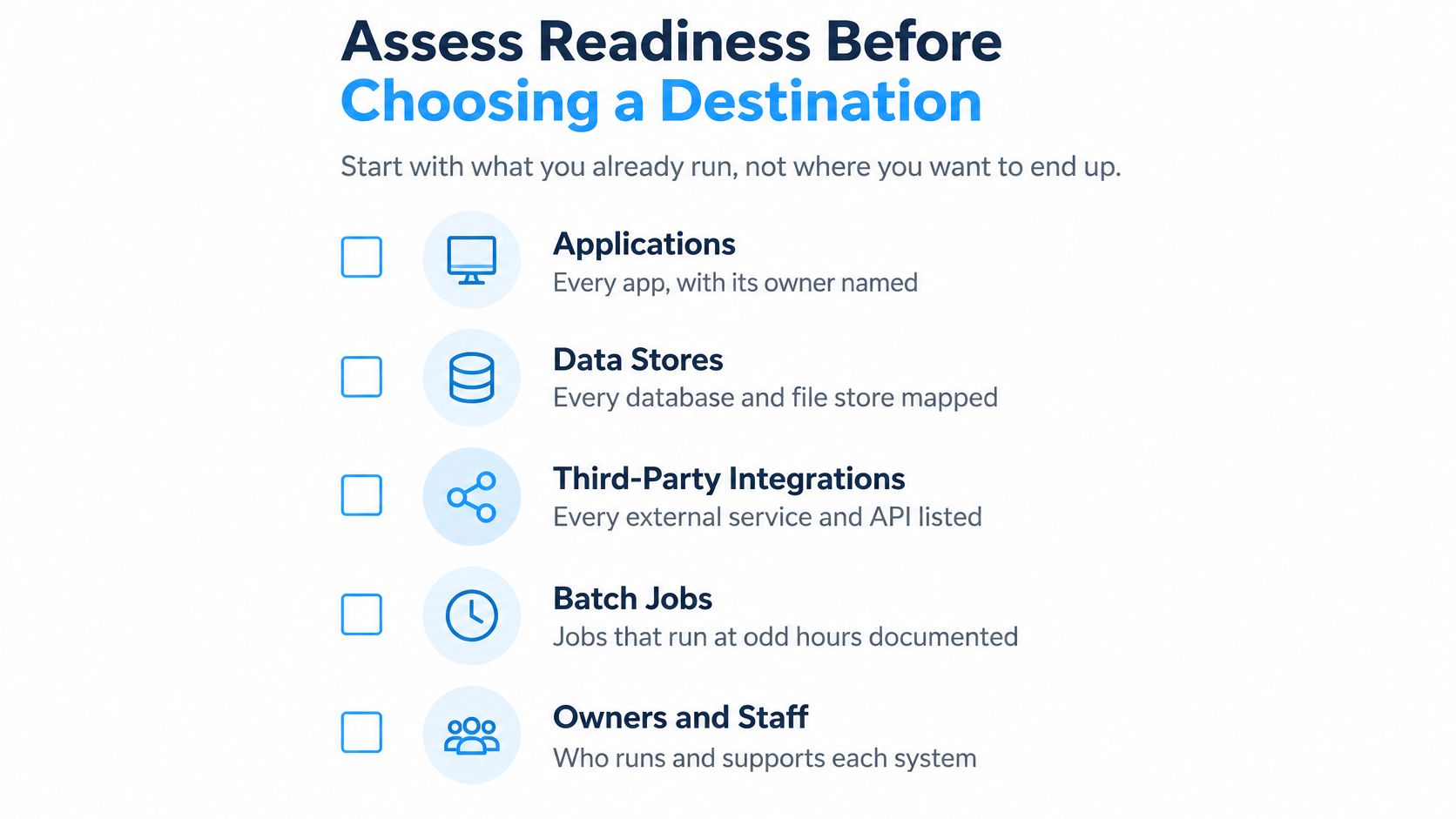
Start with what you run today. Your inventory should explain how the business uses each system, not merely list virtual machines exported from an account.
Capture enough detail for another engineer to reason about a cutover:
- Applications and owners: Name the business owner, technical maintainer, support contact, and consequence of downtime.
- Data stores: Document databases, object storage, file shares, retention requirements, and restore procedures.
- Integrations: Trace external APIs, authentication providers, payment services, and inbound callbacks.
- Scheduled work: Include batch processing, reporting exports, maintenance tasks, and jobs that run outside normal support hours.
- Operating dependencies: Record licenses, certificates, secrets, network access, and specialist knowledge.
Compare this inventory with existing accounts and bills. Look for idle environments, resources nobody recognizes, and spend without ownership tags. A forgotten test database doesn't need a migration strategy. It needs an owner's decision about deletion.
Test operating ability, not confidence
Ask an engineer to provision an environment from the repository, deploy a change, interpret an alert, and recover a failed release. Observe where they need undocumented credentials or help from a particular colleague. Those interruptions belong on the readiness gap list.
At Galliot, we start with a call with an engineer, then review the client's infrastructure, pipelines, and cloud bill and agree on a short list of what to fix first. Keep that assessment focused on blockers rather than turning discovery into an open-ended architecture exercise.
Use the NIST cloud computing definition to establish shared vocabulary: its five essential characteristics are on-demand self-service, broad network access, resource pooling, rapid elasticity, and measured service. NIST also distinguishes IaaS, PaaS, and SaaS from deployment choices such as private, community, public, and hybrid cloud.
This distinction matters during requirements discussions. Replacing a business application with SaaS is a different project from moving its existing servers into IaaS. Likewise, a private environment can support cloud operating practices without using a public provider.
Readiness rule: If nobody can explain how an application recovers, it isn't ready for a production move.
Finish with an application-level verdict: move now, fix first, or retire. Rank fixes by business impact and dependency, and attach an owner and evidence of completion to each blocker.
Decide Where Each Workload Belongs
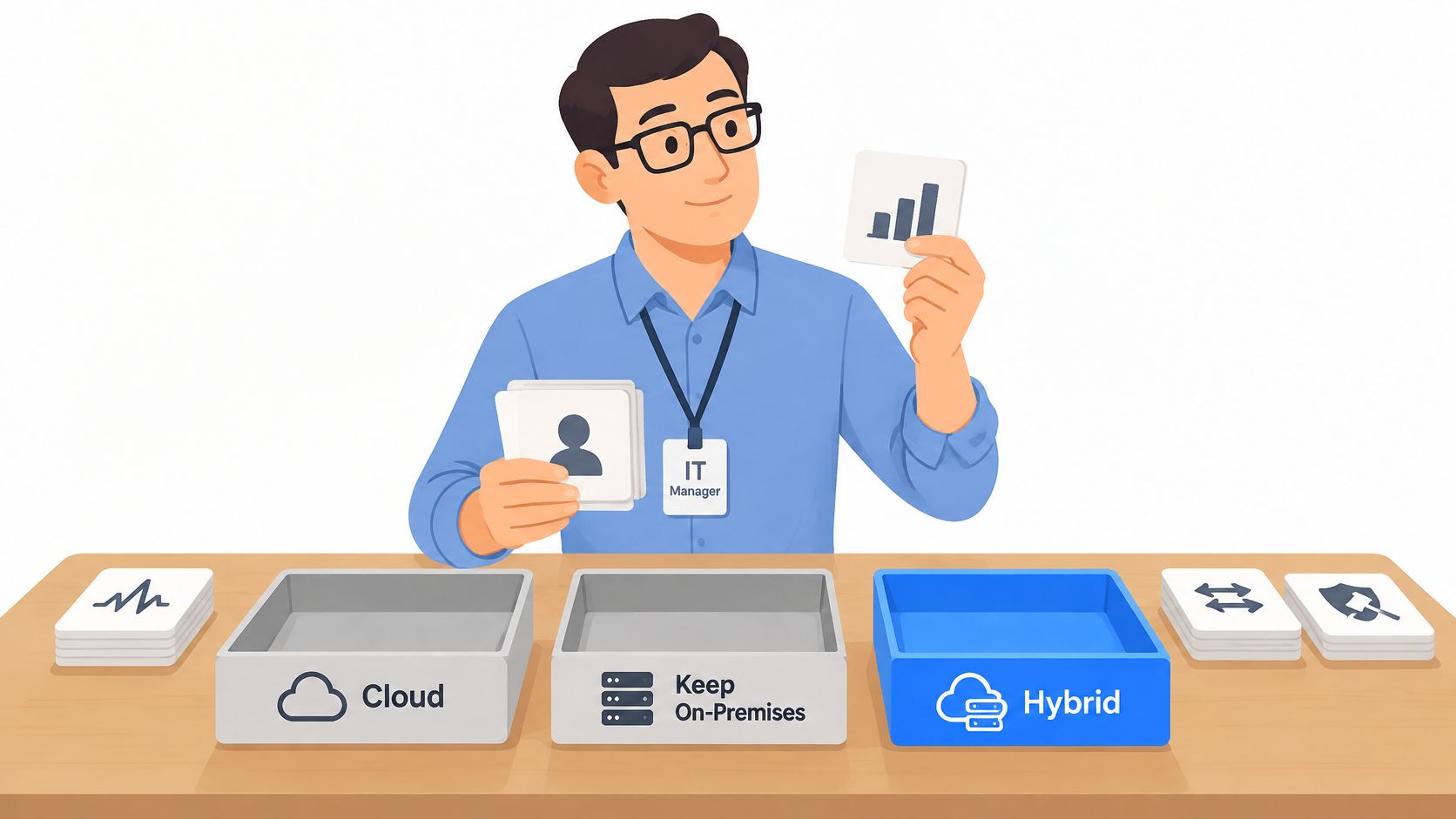
Don't score environments by preference. Score workloads against steady-state utilization, peak demand, data movement, regulatory constraints, operating staff, and exit cost.
Calculate comparable total costs over the same planning horizon. Include compute, storage, connectivity, support, licensing, backups, staffing, hardware refresh, and migration effort. A dedicated server estimate without operations labor is no fairer than a cloud estimate that omits data transfer.
| Environment | Fits best when | Watch for |
|---|---|---|
| Public cloud | Demand varies widely and managed services save engineering time | Data-transfer charges and long reserved-capacity commitments |
| Private cloud | Utilization stays high and data locality rules are strict | Hardware refresh cycles and in-house operations staffing |
| Colocation | Predictable GPU or storage load needs dedicated hardware in a chosen jurisdiction | Contract terms, power capacity and hardware lead times |
| Edge | Inference must run close to users or data has to stay on the user's side | Fleet updates, device monitoring and offline failure modes |
| Selective repatriation | A steady workload's bill has outgrown the benefit of hyperscale services | Migration effort and the cost of exiting the current provider |
Apply the test to actual work
Consider a customer-facing API with unpredictable bursts. Public cloud may fit because the team can release capacity when demand falls and avoid maintaining its own database platform. Compare the upsides and drawbacks of serverless technology before choosing a function-based design, especially where latency and execution constraints matter.
A nightly training pipeline is different. If its GPU demand is predictable and sustained, dedicated hardware in colocation may justify the operational burden. Include high-performance storage, checkpoint transfer, and idle time between jobs before deciding.
A clinical data store with strict locality requirements may suit a private environment. Public-cloud backup remains an option only if the backup location, access arrangements, encryption controls, and restore path satisfy those same constraints.
The State of FinOps 2025 report says 63% of practitioners actively manage AI spending, up from 31% a year earlier, while 30% report planned investment in data centers or private cloud. For AI placement, examine GPU utilization, high-performance storage, model-data movement, and inference volume rather than relying on CPU-hour comparisons.
Make placement reversible where it pays
Cloud-native doesn't mean public-cloud-only. Kubernetes can preserve deployment practices across environments, but it doesn't automatically make managed databases, identity systems, or storage portable. Pay for portability where the exit scenario is credible, not everywhere by default.
For that assessment, MR2 Solutions' discussion of multi-cloud migration and exit controls is a useful planning resource. Record export formats, transfer requirements, replacement services, and who can authorize an exit.
Reassess placement when utilization remains consistently high, transfer charges keep climbing, service requirements change, or a residency rule changes the permitted jurisdiction. Define those triggers in the decision record so placement doesn't become permanent through neglect.
Stand Up the Platform Before the First Wave
A landing zone should be something the team can recreate, not a collection of console changes nobody wants to touch. Build the smallest foundation that can safely host the pilot, then expand it through reviewed changes.
Build the reusable foundation
Separate environments and access. Establish distinct accounts or projects for production, staging, and sandboxes. Connect centralized identity and logging, and document emergency access that doesn't rely on someone's personal account.
Define infrastructure in code. Use Terraform or an equivalent tool for networks, identity roles, encryption settings, and baseline policies. Keep environment-specific values separate from reusable modules so another deployment doesn't require copying an entire design.
Prove delivery with a sample service. A pull request should trigger checks, produce a versioned artifact, deploy it to staging, and run a smoke test. Demonstrate rollback using the previous artifact rather than rebuilding an old release from memory.
Connect alerts to people. Configure error-rate, latency, saturation, and budget alerts before production traffic arrives. Each alert needs a resource identifier, an accountable team, and an actionable runbook.
Write the operating path. Document environment creation, deployment, rollback, approvals, and secrets handling. Keep secret values outside the repository, with an inventory describing where they live and how they're rotated.
Avoid building an internal cloud empire
Kubernetes is useful when workloads need a shared, portable orchestration layer. It's unnecessary overhead when a small service can run safely on a managed application platform. Choose the platform your team can maintain, including upgrades and incident response.
Use a cloud and platform engineering delivery checklist to frame the handoff around operational capabilities rather than installed tools. The acceptance package should include a rebuildable repository, a pipeline the pilot owner can operate, and alerts that identify the affected service and responder.
A platform isn't ready because automation ran successfully once. It's ready when another engineer can use it without the author guiding every step.
Test the foundation with a disposable environment. Destroying and rebuilding that environment exposes missing state, manual permissions, and undocumented dependencies before production depends on them.
How to Sequence Migration in Waves
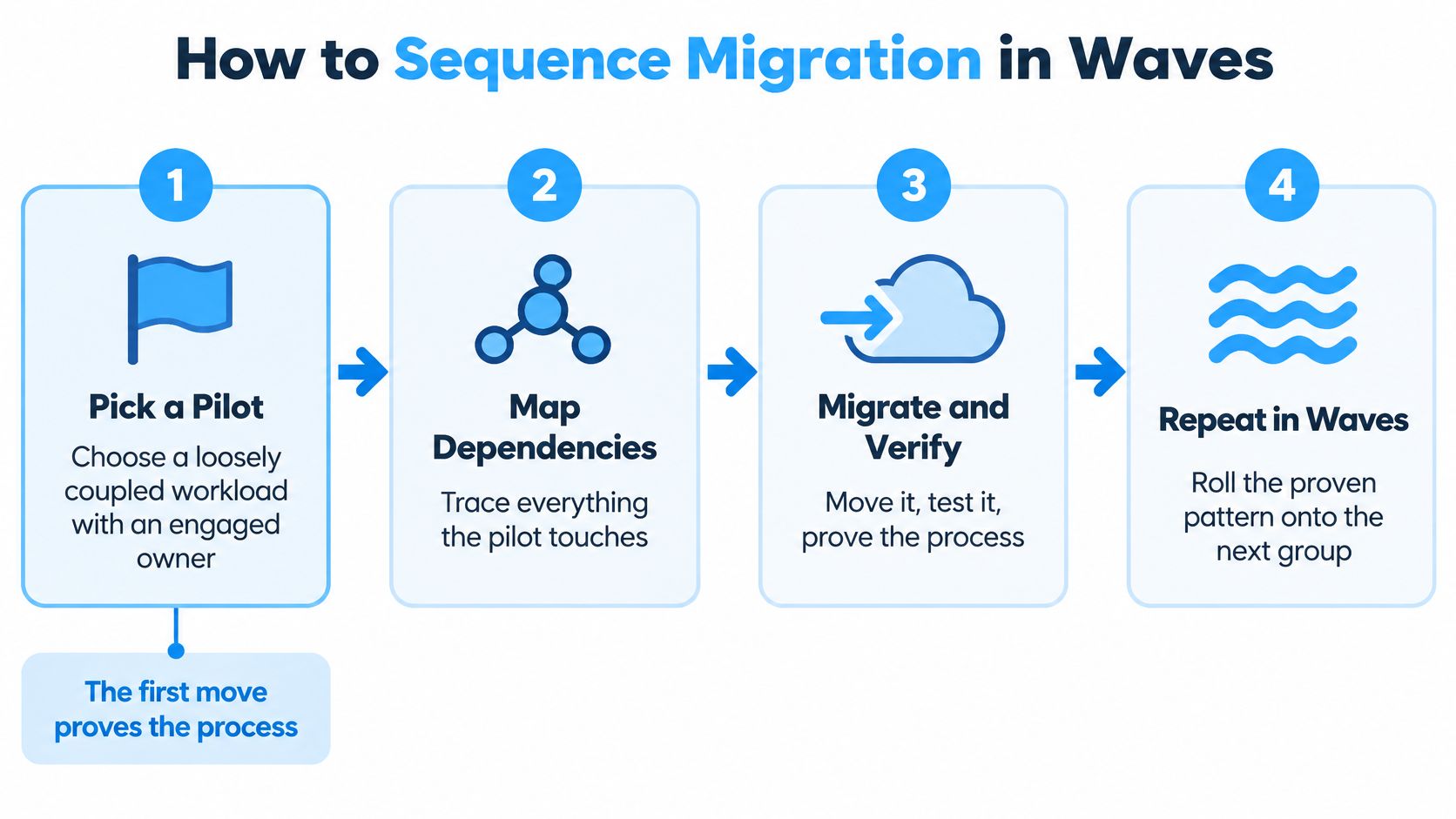
Choose a pilot that proves the migration process without making the business absorb unnecessary risk. TekRecruiter's explanation of moving workloads off on-premises infrastructure provides useful terminology for stakeholders, but the engineering work needs workload-specific acceptance criteria.
At Galliot, we use lean discovery and development to understand the client's problems and priorities before designing the solution. Apply that discipline to wave planning: group work around dependencies and business outcomes, not an arbitrary server count.
Run a controlled migration
Pick a loosely coupled pilot with an engaged owner. Choose something meaningful enough to test authentication, deployment, monitoring, and support, but with a manageable failure impact. Avoid a system nobody uses, because it won't reveal whether the process works under real demand.
Trace its dependencies and write paths. Map every service it calls, every consumer that calls it, and every job that writes to its database. Check runtime logs and scheduler configurations against diagrams, especially for reporting exports and background workers.
Instantiate the approved platform pattern. Create the destination through infrastructure as code and connect the workload to its deployment pipeline. Validate access, secrets, backup configuration, and resource ownership before copying production data.
Run in parallel and reconcile results. Exercise a complete business cycle, including scheduled jobs, and compare outputs, latency, errors, and data integrity against production. For systems with side effects, shadow requests or use isolated outputs so verification doesn't duplicate payments, notifications, or clinical actions.
Cut over with a rehearsed reversal. Write the go/no-go checks, stop conditions, decision owner, and exact rollback procedure before the window begins. Address post-cutover writes explicitly, because routing traffic backward won't reverse incompatible database changes or reconcile divergent records.
Retire the source deliberately. Wait until the destination has handled a representative peak period and the owner has accepted the result. Then remove obsolete resources, revoke unused credentials, update support documentation, and confirm that retained backups remain accessible.
Close the wave with usable evidence
Missing dependency maps can leave engineers debugging failures that never appeared in an isolated test. An unrehearsed rollback creates a different problem: the team discovers its recovery procedure while customers are already affected.
Keep an issue register for each wave. Separate defects in the shared platform from application-specific exceptions, then fix reusable problems before scheduling more workloads. Otherwise, the team reproduces the same fragile workaround across the estate.
At Galliot, every milestone includes a README that runs the project on a fresh machine, documented deployment, a secrets inventory, and an architecture note. Every week of product development ends with a demo on a staging environment the client can open themselves.
For a migration wave, add the tested rollback procedure and signed acceptance evidence to that package. A completed move includes an operable handoff, not just traffic reaching a new endpoint.
Build Resilience and Sovereignty Into the Plan
What breaks if the model vendor disappears, the GPU region becomes unavailable, the cloud control plane fails, or a cross-border route stops working? Ask those questions before labeling a design resilient.
A multicloud application can still depend on a single identity service, managed database, or model endpoint. Follow the dependency chain until you reach services that must remain available for recovery itself, including artifact registries, encryption keys, credentials, and deployment automation.
Broadcom's private-cloud outlook describes sovereignty as extending beyond storage location into operational control, technical dependencies, jurisdiction, and recoverability, and notes an EU proposal intended to at least triple data-center capacity within five to seven years. That is a proposed initiative, not available capacity your recovery plan can assume.
Define a fallback ladder
Assign critical capabilities an acceptable degradation path:
- Alternate region: Recover within the provider where the failure is regional and the required services remain accessible.
- Alternate cloud: Use an independently deployable environment when provider-level dependencies justify the additional expense.
- Private or on-premises inference: Maintain a local execution path where capacity, model rights, and data access permit it.
- Smaller model: Substitute a validated model with lower hardware requirements and documented quality limits.
- Degraded functionality: Disable nonessential features while preserving the core transaction or workflow.
- Offline operation: Keep essential procedures usable without network access, with a controlled reconciliation process afterward.
Don't promise every tier for every service. Select the cheapest fallback that meets the business requirement, then fund the capacity and testing needed to make it credible.
Test recovery and retain control
Set recovery-time objectives for how quickly service must return and recovery-point objectives for acceptable data loss. Test both through restoration and replay, not by checking whether backup jobs finished.
Specify portability for model weights where licensing permits, feature stores, vector indexes, identity configuration, telemetry, and deployment automation. For healthcare and life-sciences workloads, include model versions, training-data references, and validation evidence needed to restore an approved service.
Use monitoring in DevOps to design checks around user-visible recovery. An alternate environment that accepts connections but returns unusable predictions hasn't restored the business capability.
Ownership matters: Recovery access shouldn't depend on the availability or goodwill of a departing supplier.
At Galliot, clients own what we build, and repositories, cloud accounts, and app store accounts are in the client's name. Apply that same ownership discipline to recovery credentials and operational documentation.
Control Spend Once Workloads Are Running
| Spend signal | Usual cause | First action |
|---|---|---|
| Compute cost rising while traffic stays flat | Idle or oversized instances left running | Right-size instances and schedule shutdowns for non-production environments |
| Data-transfer charges climbing | Services in different regions or clouds exchanging large volumes | Move chatty services closer together and review cross-region paths |
| GPU bill spiking | Training or inference jobs running without limits or with idle GPUs | Set job quotas, autoscale inference and review utilization per model |
| Spend with no owner | Untagged resources left from pilots or abandoned tests | Enforce mandatory tags and remove resources past their review date |
These signals are investigation prompts, not automatic deletion instructions. Flat traffic can hide a legitimate increase in background processing, while an idle instance may be deliberate recovery capacity. Require the service owner to explain the resource's purpose before changing it.
Give the review an operating rhythm
Set ownership tags and budgets before production cutover. During migration, review spend weekly to catch parallel-running environments and temporary transfer costs. Move to a monthly review once operations stabilize, while retaining alerts for unexpected changes.
Bring billing exports together with utilization, request volume, queue depth, and deployment history. An alert that spending increased is incomplete unless the responder can identify the resource, its owner, and what changed.
Kogifi's guide to cloud spend for IT directors can support the management discussion. Keep the engineering review grounded in specific actions: resize, schedule, delete, consolidate, renegotiate, or reassess placement.
Separate waste from commitment decisions
Idle capacity is a cleanup problem. Steady demand is a purchasing and placement decision. Remove unnecessary capacity before buying a commitment, or you risk discounting resources the application never needed.
For justified steady load, compare reserved or committed capacity with dedicated alternatives. Include contract flexibility and expected architecture changes, not just the apparent unit discount. A long commitment can be a poor purchase for a service scheduled for replacement.
For AI services, review GPU occupancy, model loading, storage throughput, token or request volume, and retries. Attribute shared inference costs using a documented allocation rule so teams can explain their consumption.
Close the review with a hypothetical stress test: if the budget were cut materially, which spend would we remove first? Record the business consequence of each cut, then turn the least painful options into assigned work.
Choose Your First Milestone and Owner
Choose a milestone small enough to finish within a quarter and substantial enough to prove the process. Don't make the hardest application the admission test for the entire program.
If there's no trustworthy inventory, deliver that inventory with an application-by-application verdict: move now, fix first, or retire. Include the dependencies and blockers needed to defend each decision.
Make completion checkable
If the inventory exists, choose a landing zone and a loosely coupled pilot. Name an owner who ships the work and a reviewer who accepts the evidence.
Write the exit criteria before implementation begins:
- Delivery works: The owner can provision the environment and release the application through the pipeline.
- Behavior is acceptable: Agreed outputs, error rates, and latency meet the production comparison criteria through a complete business cycle.
- Recovery is demonstrated: Restore and rollback tests meet the agreed recovery objectives.
- Operations have ownership: New resources have accountable owners, budgets, actionable alerts, and current runbooks.
If infrastructure-as-code skills or delivery bandwidth are the blocker, scope outside help around the foundation and initial wave. Keep operational decisions with the named internal owner and require a usable handoff.
Galliot is a software development and AI consultancy whose cloud foundations cover architecture, migration, Kubernetes, CI/CD, and infrastructure as code on AWS, Azure, Google Cloud, or hybrid environments with on-premises hardware. Judge that help by the inventory, working pipeline, and tested rollback, not a savings claim borrowed from another workload.
A cloud computing roadmap becomes useful when someone can accept or reject its outputs. Put the milestone, owner, reviewer, and exit criteria into the delivery backlog before approving the next infrastructure purchase.
Galliot can help assess your current infrastructure, establish a cloud foundation, and deliver a controlled migration wave with documented deployment and recovery procedures. Visit Galliot to discuss your application inventory, operating constraints, and the pilot that would best test your roadmap.
Get Started
Have a question? Send us a message and we will respond as soon as possible.
Leave us a comment