Dedicated Software Development Team: Model, Roles and Fit
Your roadmap keeps growing, but your engineers are already splitting their time between new features, production issues, and unfinished platform work. Hiring might help eventually. Right now, you need people who can learn the product and keep contributing without another handoff after every release.
A dedicated software development team can provide that continuity. But buying engineering capacity isn't the same as creating delivery capacity. The model works when your internal leaders can set priorities, resolve questions, and give external engineers clear authority to act. The hourly rate matters, but ownership and decision speed matter more.
Table of Contents
- What a Dedicated Software Development Team Is
- Roles Inside a Dedicated Team and How Many You Need
- How Collaboration Works Day to Day
- Measuring Delivery Without Counting Activity
- Governing AI-Assisted Work on Sensitive Systems
- When a Dedicated Team Fits and When It Does Not
- Confirm the Team and Terms Before You Sign
What a Dedicated Software Development Team Is
Hiring a dedicated team is like signing a long-term lease on a kitchen crew instead of hiring a new crew for every event. The same people learn your menu, equipment, and quality standards. You still decide what gets served.
In software, the model means an external group of engineers works exclusively on your product, takes day-to-day priorities from your organization, and stays together across releases. The vendor handles employment and team administration. Your product owner directs the work, while the engineering leads coordinate implementation.
Say you're building a scheduling application. Rather than handing a vendor a specification and waiting for a finished system, you work with engineers who implement booking, learn why cancellations behave differently for different customers, and carry that understanding into later changes.
How the model developed
External engineering isn't just a way to move repetitive coding elsewhere. The OECD's account of offshoring6/en/pdf) traces manufacturing relocation to the 1960s, routine IT offshoring to the late 1990s, and increasing offshoring of knowledge-intensive work, including engineering and product design, to 2005–2015. Dedicated teams belong to that broader shift toward sustained access to technical capabilities.
According to Deloitte's 2024 Global Outsourcing Survey, 72% of organizations surveyed outsourced application or software development, as reported by Arcforth's software outsourcing summary. That establishes outsourcing's prevalence, not the suitability of any particular contract.
Hiring models compared
| Model | Who sets daily priorities | Typical engagement | Team continuity |
|---|---|---|---|
| Dedicated team | Client, working with the vendor's team lead | Months to years | Same engineers across releases |
| Project outsourcing | Vendor, against a fixed scope | One defined project | Team can change at milestones |
| Staff augmentation | Client, managing individual hires | Months | Individuals join the client's team and may rotate |
| In-house hiring | Client | Permanent | Maintained through retention and replacement hiring |
The distinction buyers often miss is a team versus individual placements. If you already have delivery leadership and need a specialist inside an existing squad, nexus IT group's guide to when to use IT staff augmentation is a useful comparison.
Don't choose based on the label alone. Test whether your work needs a continuing team, whether you can direct it, and whether the commitment suits your roadmap.
Roles Inside a Dedicated Team and How Many You Need
Start with responsibilities, not a package of developer seats. For planning, consider a hypothetical core of five to eight people assigned to one product. That's an example structure, not a minimum requirement or an industry benchmark.
The hierarchy begins with your client product owner, who sets priorities and approves product direction. Beneath that role, the external tech lead or architect keeps implementation coherent and resolves technical questions within agreed boundaries. Developers, QA, design, and DevOps form the working layer.
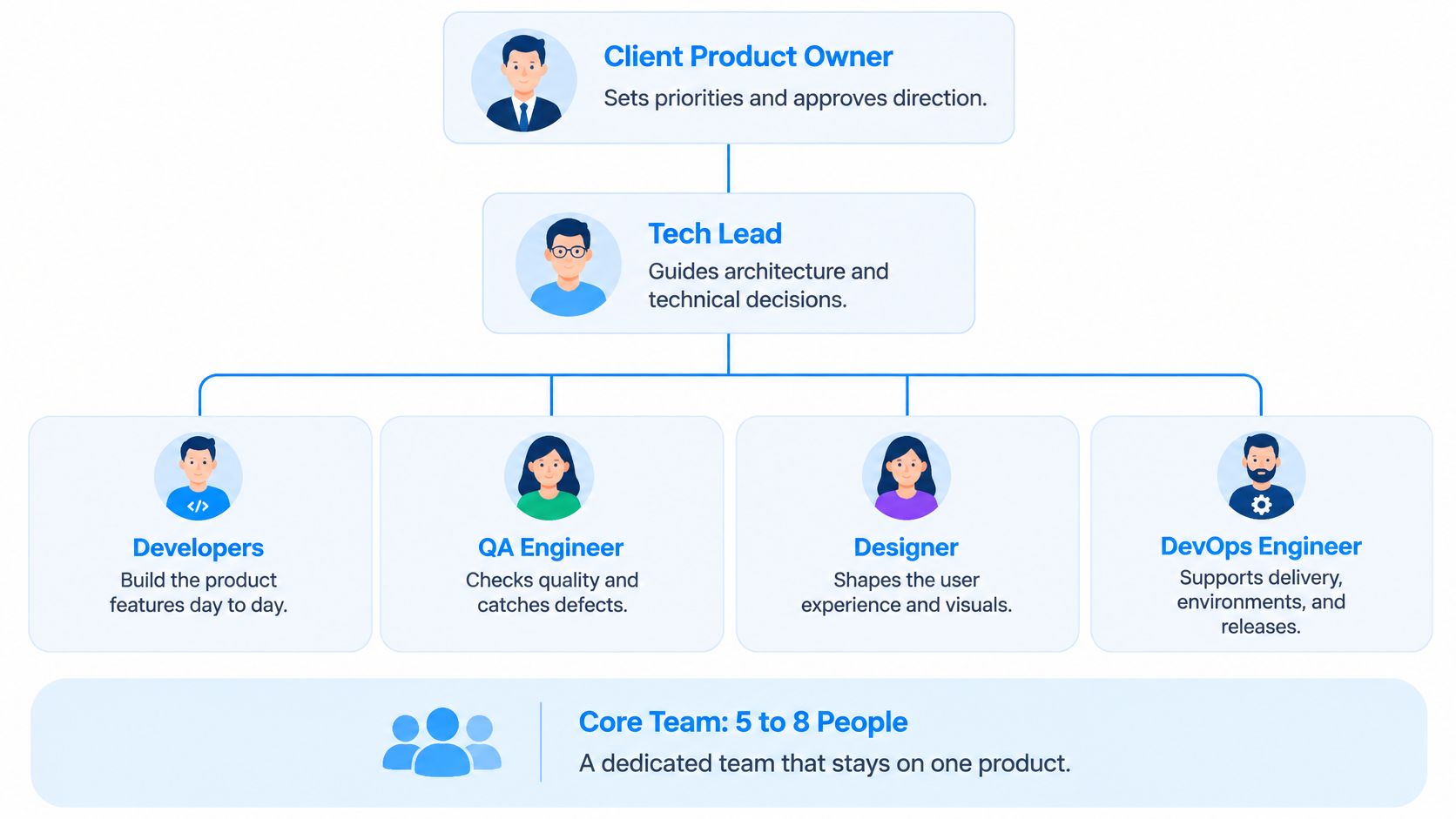
A tech lead doesn't replace the product owner. The lead can explain how to implement account permissions, but your organization must decide which customers are entitled to which permissions.
Build the team around the work
The following six-person configuration is an illustrative staffing plan. Its dedicated seats total six; the designer contributes shared capacity outside that core.
Typical roles in a six-person dedicated team
| Role | Main responsibility | Typical seats in a six-person team |
|---|---|---|
| Tech lead or architect | Keeps design consistent and reviews major decisions | 1 |
| Backend engineers | APIs, data models, and service logic | 2 |
| Frontend or mobile engineer | Client-facing interfaces and app code | 1 |
| QA engineer | Test plans, automation, and release checks | 1 |
| DevOps or platform engineer | Pipelines, cloud infrastructure, and monitoring | 1 |
| Product designer | UI/UX design and user flows | Shared with another team |
Adjust this configuration to the backlog. A backend-heavy integration product might need additional service-development capacity. A mobile application needs someone who understands device behavior and release requirements, while infrastructure-heavy work needs an engineer who owns pipelines rather than treating deployment as spare-time work.
Our Montevideo, Uruguay, team provides full-stack software development, QA, and DevOps. Our broader technical expertise includes Kubernetes, Pytorch, Terraform, Tensorflow, React, Android, GCP, and AWS. Match those capabilities to actual tasks rather than collecting technology names in a proposal.
If you're also comparing individual regional hires, LatHire's Hire LATAM developers resource can help frame that sourcing alternative. Regional access and team composition are separate decisions.
Staffing rule: Hire for the work you can define and supervise, not for the headcount you hope will accelerate everything.
As a planning exercise, list the next six months of work, map each item to a role, and identify gaps in your existing organization. Grow the team only when the backlog and your capacity to make decisions grow together.
How Collaboration Works Day to Day
A dedicated team should work inside your delivery process, not send you summaries from a parallel project. If external engineers maintain separate tickets, repositories, and approval paths, your managers must reconcile two versions of reality.
Before the first sprint, establish the onboarding path. Confirm the named engineers before granting repository access, provide a shared glossary of product terms, and schedule an architecture and release-process walkthrough during the opening week. Give each engineer a named contact for questions that documentation doesn't answer.
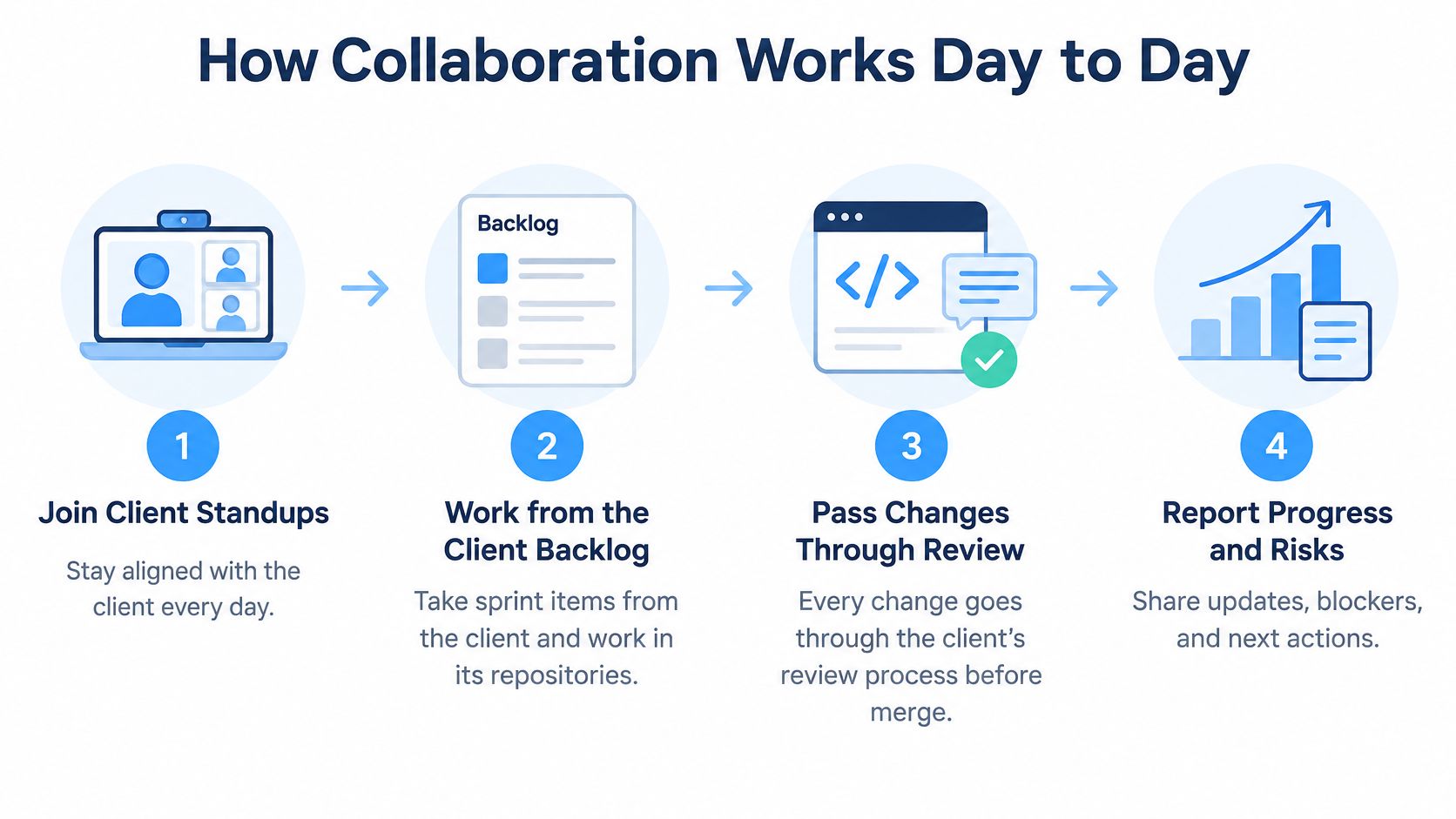
Establish a shared delivery rhythm
Use this recurring sequence:
- Join the client's standups. Discuss blockers and dependencies with the people who can resolve them, rather than holding a vendor-only meeting that needs another status report.
- Pull work from the client's backlog. Each item should include acceptance criteria, relevant designs, and unresolved questions. Engineers work in the client's repositories.
- Review changes before merge. Apply the client's branch protections, automated checks, and code-review process. Name reviewers before work waits in a queue.
- Demo finished work on staging. Show behavior the client can inspect, not slides or screenshots standing in for working software.
- Review delivery and retrospective actions. The product owner and engineering leads discuss delays, quality problems, and actions with named owners.
At Galliot, our engineers join the client's standups, work in its repositories, and follow its review process. Every week of product development ends with a demo on a staging environment the client can open themselves.
Put authority in writing
A shared backlog doesn't settle operational ownership. Record these boundaries explicitly:
- Production deployment approval: Name who authorizes releases and who executes them.
- On-call responsibility: Identify who responds to alerts, who supports diagnosis, and who communicates incidents.
- Architecture authority: Separate decisions the team can make independently from changes requiring client approval.
- Access administration: Assign responsibility for granting, changing, and revoking repository and environment permissions.
Say a client adds an external team of three to a payments feature. As a working agreement for this example, internal engineers commit to reviewing pull requests within a day. That makes the opening sprint workable because payment rules and integration questions get resolved while the external engineers still have the context fresh.
Without reviewer availability, those engineers might finish implementation and still be unable to merge anything. The missing input isn't more coding time.
Maintain one shared backlog, shared chat channels, and a written decision log recording who chose what and why. Healthy collaboration is visible: people can find work status without asking, reviews meet the agreed response window, and demos produce feedback rather than surprises.
Measuring Delivery Without Counting Activity
Hours billed, tickets closed, and lines of code measure activity. They don't tell you whether useful, reliable changes reached customers. A team can close many small tickets while a critical release remains blocked.
Use DORA metrics to connect throughput with stability. Flagsmith's explanation of DevOps delivery evidence summarizes research covering more than 23,000 survey responses that found a positive relationship between higher software throughput and stability. Faster delivery doesn't require accepting more failures.
Delivery metrics for a dedicated team
| Metric | What it reveals | Warning sign |
|---|---|---|
| Deployment frequency | How often changes reach production | Releases bunch up into large drops |
| Lead time for changes | Time from commit to production | Work waits in review or approval |
| Change failure rate | Share of releases that cause an incident | Failures rise after the team grows |
| Mean time to recovery | How quickly service is restored | Rollback steps are unclear or untested |
Interpret the numbers in context
Compare the team with its own baseline or comparable systems. A regulated service with formal release approval shouldn't be ranked against an unrelated application with a different architecture and deployment policy.
The SPACE framework describes developer productivity through satisfaction and well-being, performance, activity, communication and collaboration, and efficiency and flow. Pair delivery metrics with review latency, handoffs, and developer satisfaction so you can distinguish implementation problems from coordination problems.
Faster typing isn't faster delivery when the resulting changes wait longer for review.
Use small changes, automated CI/CD checks, production observability, and tested recovery procedures. Our guide to monitoring in DevOps provides practical context for making production behavior visible.
Establish checkpoints and investigate delays
A useful proposed measurement schedule is to establish a baseline during the opening month, then review progress at subsequent monthly checkpoints. Capture timestamps from your repository and deployment system rather than reconstructing them from status reports.
Track escaped defects alongside speed. Assess documentation quality by whether another engineer can set up the service, explain its dependencies, and follow its release instructions without private guidance.
AI makes this distinction especially important. Atlassian's developer experience report found that 99% of developers save time with AI, yet 90% lose at least six hours per week to organizational friction. AI-assisted coding can also add review and integration work, so watch those queues and defect escape rates.
If coding finishes quickly but lead time remains long, inspect approvals, ownership, and missing product decisions before adding engineers. Identify where work waits, then assign someone authority to remove that delay.
Governing AI-Assisted Work on Sensitive Systems
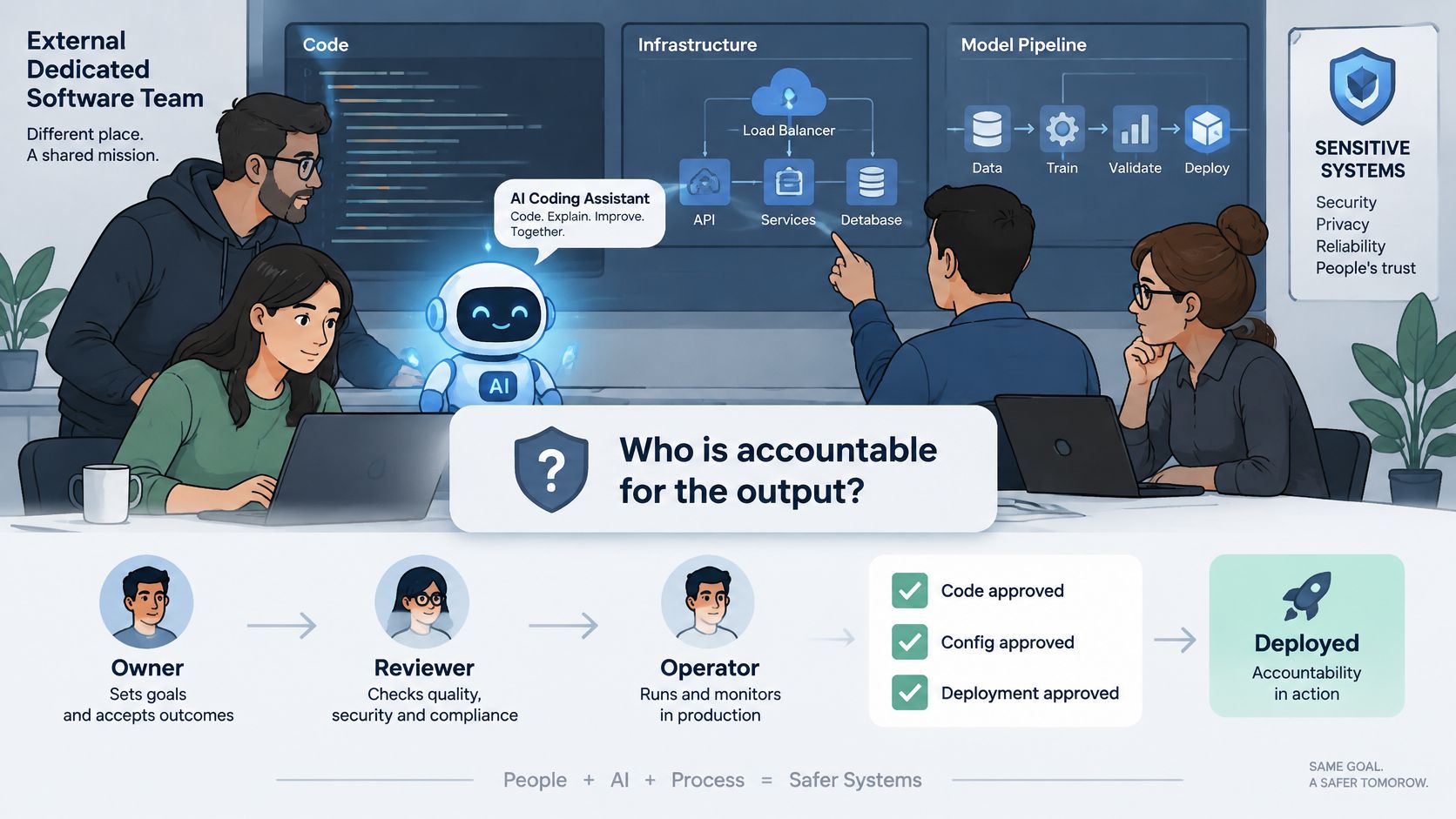
When an external engineer uses an AI coding assistant, generates infrastructure configuration, or deploys a model, who answers for the output? The engineer who accepted the suggestion remains responsible for its implementation. Your organization also needs an explicit approval and escalation path.
This isn't an edge case. Google's 2025 DORA report discussion reports 90% AI adoption among surveyed technology professionals. Tool familiarity alone doesn't establish that sensitive information is handled appropriately.
Define controls before granting permission
Agree on a written operating policy covering:
- Approved tools and prohibited data: Specify permitted services. Keep patient records, credentials, and sensitive production logs out of prompts.
- Retention and repository boundaries: Define whether prompts or code can be retained, where they're stored, and who can access them.
- Code verification: Require human review, software-composition analysis, and license checks for AI-assisted changes.
- Build and release evidence: Use reproducible builds, audit logs, documented deployment approvals, and tested rollback procedures.
- Model evaluation and escalation: Define evaluation criteria before release and name the owner who handles unsafe output or suspected disclosure.
For example, a healthcare team can build tests with synthetic patient records rather than real exports. An AI-suggested Terraform change should enter a reviewed pull request with logged approval, not bypass controls because the assistant produced plausible configuration.
Apply the same discipline to machine learning
A platform running on AWS, GCP, or on-premises needs traceable training data, model versions, evaluation results, and deployment authorization. Record which model artifact is serving requests and how operators restore the previous version.
Our team designed the architecture of our ML operations platform and managed its deployments and services for healthcare customers. That work makes operational ownership relevant to the engagement, not just application coding. The broader approach belongs within enterprise-level software development, where release controls and accountability accompany implementation.
Governance maturity matters more than AI fluency alone. Before approving AI-assisted work, request the written policy, a sample audit trail, and a documented rollback. Review the actual artifacts rather than accepting a claim that the team develops securely.
When a Dedicated Team Fits and When It Does Not
The dedicated model fits when work continues beyond a single project and benefits from keeping the same people across releases. It's less appropriate when you need a bounded deliverable and don't want an ongoing delivery relationship.
Deloitte's 2024 Global Outsourcing Survey found that 80% of executives surveyed planned to maintain or increase their investment in third-party outsourcing, according to Near's outsourcing statistics summary. That indicates sustained interest in outsourcing broadly. Popularity doesn't prove fit for your product.
Compare your operating conditions
A dedicated team is a strong candidate when:
- The roadmap continues: Features, maintenance, and platform work form a sustained backlog.
- Product context matters: Engineers need to understand business rules across successive releases.
- Internal recruitment can't meet the need: You have defined work but insufficient available capacity.
- An internal owner can decide: A product owner can resolve scope and acceptance questions promptly.
Another model may be better when:
- The scope is short and fixed: A defined project can end with delivery and acceptance.
- Nobody owns product decisions: Adding engineers won't resolve competing stakeholder instructions.
- Requirements are unformed: Start with discovery rather than committing to implementation capacity.
- You need immediate contraction: A continuing team may conflict with your required exit flexibility.
For a closer comparison of contractual responsibilities, GENTY recruitment's discussion of delivery ownership and cost trade-offs helps distinguish individual augmentation from outsourced delivery.
Test the model against concrete cases
Consider a hypothetical startup with two founding engineers that needs four additional engineers for nine months of feature work. A dedicated team can be appropriate if the founders have enough attention to settle product questions and support integration. It's not appropriate if they expect the external team to discover the business strategy while delivering it.
Now consider a healthcare company aiming to deliver a compliant platform in six months. The model can work only after the organization defines governance, acceptance evidence, and approval authority. Staffing doesn't itself establish compliance.
Working-day overlap also affects practicality. Our engineers are based in Europe and South America, giving real overlap with clients in the US and Europe. Confirm the actual shared working window for the proposed team rather than relying on a regional label.
Decision test: A dedicated team can extend your engineering organization. It can't replace product decisions your organization hasn't made.
Confirm the Team and Terms Before You Sign
A proposal should identify the people and operating agreement you're buying, not just a rate and a collection of skills. Before signing, turn assumptions into written commitments.
- Meet the proposed engineers. With us, you meet the lead engineer and the rest of the team before signing, and you can decline. Use that conversation to test how they explain trade-offs and ask product questions.
- Confirm identity and access. Our team named in the proposal is the team on the repository. Document how substitutions will be proposed and approved.
- Agree on measurement. Write down the baseline process and opening checkpoint, including where delivery evidence will come from.
- Assign operational ownership. Record deployment authority, on-call responsibilities, and architecture decision boundaries.
- Define the exit. Specify notice, knowledge transfer, code ownership, and access revocation. Identify required handover artifacts, including runbooks and environment documentation.
- Confirm delivery rituals. Put review expectations and the demo schedule in the agreement so both sides reserve the necessary time.
- Approve sensitive-work controls. Include an AI governance policy when the engagement involves sensitive data or systems.
Match the commercial terms to the work
Clarify what you're purchasing: continuing capacity, a defined deliverable, or a combination. Our comparison of time and materials versus fixed price can help you evaluate the commercial structure without confusing it with team ownership.
The first practical step is a short note describing your setup, product stage, and goals. With us, an engineer replies rather than a sales team. Request a conversation with the proposed lead before discussing a contract.
Proceed only when the team, process, and exit terms are clear in writing, and your internal product owner has committed to the decision rhythm the work requires. An attractive rate isn't a substitute for that agreement.
Galliot offers product engineering, QA, cloud infrastructure, and machine learning capabilities that can extend your existing engineering team. Visit Galliot and send a few lines about your product, current setup, and delivery goals to start an engineer-led conversation about the roles and collaboration model you need.
Get Started
Have a question? Send us a message and we will respond as soon as possible.
Leave us a comment