Cloud Infrastructure Management: Roles and Practices
Your cloud bill has climbed, a production alert is firing, and nobody's sure whether the application team or the infrastructure partner should respond. The deployment pipeline still works, but someone changed a firewall rule in the console, and the person who understands it is offline.
Cloud infrastructure management is an ownership problem before it's a tooling problem. Your team needs named decision-makers, repeatable changes, actionable alerts, and recovery instructions that another engineer can follow. Buying another dashboard won't resolve an unanswered question about who can change production.
Who Owns Which Part of Cloud Infrastructure
Typical ownership of cloud infrastructure areas
| Area | Typical owner | Example task |
|---|---|---|
| Facilities, power and physical hardware | Cloud provider | Provider replaces failed servers in its data centers |
| Virtual machines and OS patches | Your team on IaaS, provider on managed PaaS | Rebuild machine images monthly from a patched base |
| Network design and connectivity | Your team | Define subnets, routing rules and VPN links |
| Identity and access | Your team | Grant roles per service and review them quarterly |
| Backup and recovery | Your team, using provider backup tools | Set retention periods and run restore tests |
| Monitoring and incident response | Your team, with provider for platform incidents | Maintain alert rules and the on-call rota |
| Cost and budgets | Your team with finance | Enforce tagging and review spend by team each week |
Treat these cadences as a starting operating policy, not universal deadlines. Replace “your team” with a named accountable person and a backup. A department name doesn't tell an on-call engineer whom to contact.
Separate execution from accountability
Under shared responsibility, the provider maintains some layers while your organization controls others. Your operational share shrinks as you move from infrastructure as a service to managed platforms and finished software. The provider takes on more, but accountability for your data, access choices, and customer-controlled configuration remains yours.
Think of a hotel. The hotel maintains the building and plumbing; you decide who gets a room key and what you store inside. A managed database similarly removes underlying maintenance work without deciding which application should have permission to read patient records.
When preparing to migrate legacy systems to cloud, Wisely's migration resource provides context for the transition. Make the ownership agreement part of that preparation rather than leaving it until the migration team hands over production.
Practical rule: Delegating a task doesn't remove the need for an internal owner who verifies the result.
Before handing any area to a partner, settle who holds the accounts, who receives the alerts, and who can change production. Keep repository, cloud, and app store accounts in the client's name. At Galliot, the client owns what we build, and those accounts remain in the client's name.
The Model Behind Cloud Operations
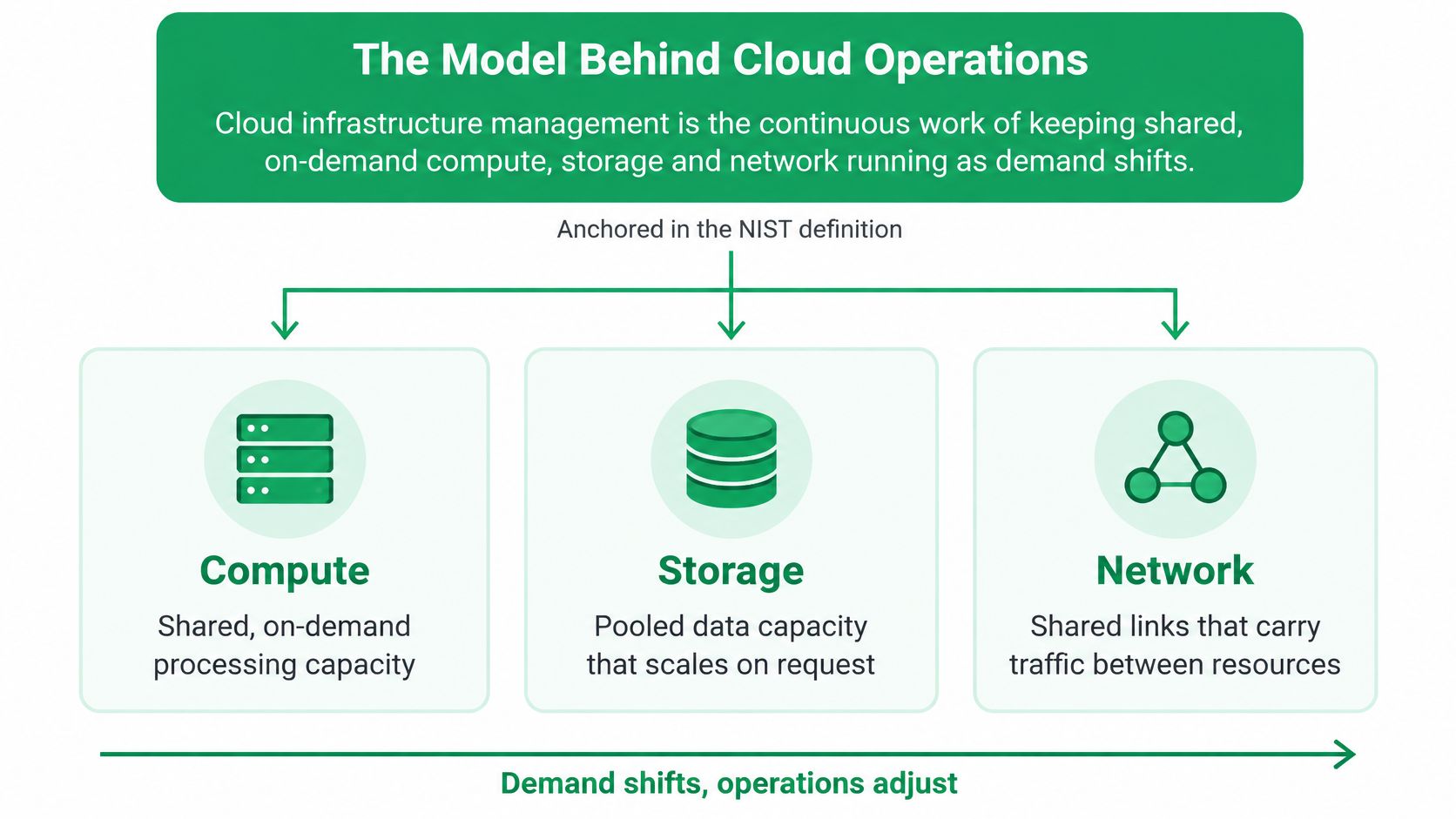
Cloud infrastructure management is the continuous work of keeping shared, on-demand compute, storage, and network resources running as demand shifts. It includes deciding what teams may provision, how resources scale, and how operators verify that services remain usable.
The NIST definition of cloud computing, published in Special Publication 800-145 in 2011, describes pooled, configurable resources that can be provisioned and released with minimal management effort. Its five essential characteristics translate directly into operating duties.
Turn cloud characteristics into duties
- On-demand self-service: Teams can provision resources without a manual provider request. Establish approved templates, spending boundaries, and restrictions on public exposure.
- Broad network access: Services are reachable across networks and devices. Decide which endpoints should be public and which require private connectivity.
- Resource pooling: Shared infrastructure needs explicit workload isolation and resource allocation. Track which service owns each allocation.
- Rapid elasticity: Capacity can expand and contract. Set scaling limits and test whether downstream databases can handle the added traffic.
- Measured service: Usage is metered. Connect consumption records to services and accountable budget owners.
Distinguish service models from deployment models
IaaS gives you machines and infrastructure to configure. PaaS supplies a managed platform onto which you deploy applications. SaaS supplies finished software, leaving less of the technical stack for your team to operate.
NIST also distinguishes private, community, public, and hybrid deployment models. These describe how infrastructure is made available, not how much application maintenance the provider performs. Don't assume that a private cloud is fully managed or that every public-cloud service has the same operational boundary.
The utility analogy helps: the utility operates the grid, while your team maintains the house's wiring and decides what to connect. Run a simple estate review: list every layer, from compute through application dependencies, and mark who patches, who scales, and who pays.
Provisioning and Changing Infrastructure Safely
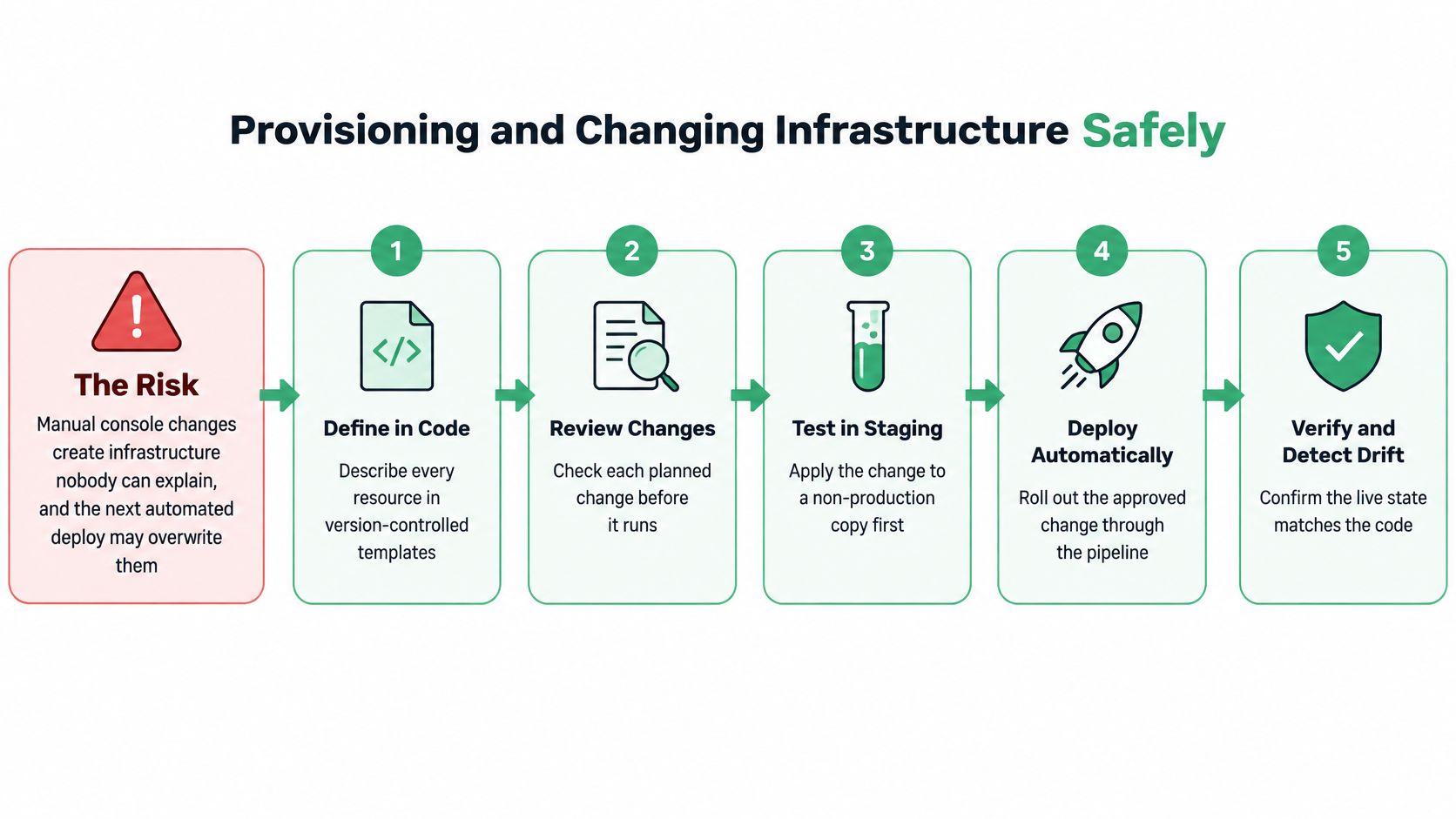
Manual console changes create infrastructure nobody can reliably explain. Worse, the next automated deployment may overwrite an emergency fix because the approved configuration never included it.
Use infrastructure as code, such as Terraform configuration stored in Git, to make the intended state reviewable. The delivery pipeline should execute approved changes, not replace engineering judgment.
Follow a controlled change path
- Define environments in version-controlled files. Describe networks, compute, permissions, and supporting services in code. This gives reviewers a durable record of intent.
- Review the planned change before applying it. Inspect the diff, meaning the list of resources to be created, modified, or deleted. Pay particular attention to replacements, permission expansion, and database destruction.
- Apply the template to staging. Keep staging structurally aligned with production while documenting deliberate differences in scale or data. A successful test against a materially different environment proves little.
- Roll out production changes progressively. Start with a limited deployment or a small share of traffic where the architecture supports it. Don't expose every instance to an unverified change.
- Check health signals for a defined observation window. Agree on error, latency, and saturation thresholds before deployment. The release owner should stop expansion when those thresholds fail.
- Keep rollback instructions written and rehearsed. Specify the previous artifact, configuration, and responsible operator. Database changes may need a forward repair rather than a simple code reversal.
Say an engineer manually opens a security group during an overnight database incident. The next scheduled deployment removes the untracked rule, and connections fail again. The lasting fix is to capture the approved rule in code and reconcile the live environment, not to repeat the console edit.
Make handover part of the change
For workloads such as scaling telephony agents on your own cluster, Dograh's deployment guide offers a concrete workload context. Your own release process still needs to account for application behavior, capacity, and failed updates.
Apply owner, environment, and service tags through code. Reject missing ownership metadata during review rather than trying to reconstruct it from the bill.
At Galliot, every milestone includes a README that runs the project on a fresh machine, documented deployment, a secrets inventory, and an architecture note. Keep secret locations and access procedures in that inventory, never secret values.
Keeping Systems Available and Recoverable
Moving to cloud doesn't eliminate outage risk. It redistributes risk across providers, regions, customer configuration, and application dependencies.
The Uptime Institute's 2024 annual outage analysis reported that 54% of respondents to its 2023 data-center survey said their most recent significant, serious, or severe outage cost more than $100,000, while 16% said it exceeded $1 million. The analysis also identified power problems as the most common cause of serious and severe data-center outages.
Monitor the service users depend on
Define a service-level objective, an agreed target for successful service behavior over a measurement period. Measure completed requests, response latency, or successful workflow completion rather than treating a running server as proof of availability.
Use metrics to detect symptoms, logs to investigate events, and traces to follow requests across services. Galliot's explanation of monitoring in DevOps provides useful context for connecting those signals to operations.
Page a person for symptoms that need immediate action. Route predictive capacity warnings and nonurgent maintenance findings into owned work queues instead.
Test recovery beyond the traffic switch
Use the three-copy, two-media, one-offsite backup pattern as a design starting point: retain the working data and independent backups, diversify storage failure domains, and keep a copy outside the primary location. For managed cloud services, verify isolation across accounts, permissions, and locations rather than counting snapshots that share the same deletion risk.
A backup you've never restored is an unverified recovery assumption.
Set acceptable recovery time and acceptable data loss with the business owner. Restore into an isolated environment and verify application behavior, permissions, and data integrity.
For many workloads, multiple availability zones within a region are a sensible starting point. Multi-region recovery can address broader failures, but adds replication expense, operational coordination, and difficult decisions about writes during a network partition.
Consider a hypothetical payments API running in a single zone. When that zone fails, health checks reroute traffic, but nobody promotes the database replica. The application remains unavailable despite a successful traffic switch. Test the complete recovery path, including database promotion, credentials, queues, and external dependencies.
Define incident severity levels, name an incident lead, and maintain runbooks for your most consequential failure modes. Each runbook should identify the relevant rollback procedure. At Galliot, our Launch stage covers release, app stores, and monitoring, and ends with monitoring and alerts plus documented deploy and rollback steps.
Securing Access and Keeping Systems Patched
Over-broad access that nobody reviews creates an avoidable path from a small mistake to a production-wide incident. An engineer who only needs to inspect logs shouldn't also be able to delete databases.
Start with a permission inventory, not another security product. Separate human identities from service identities, then document why each privileged role exists.
Establish an access baseline
- Least privilege: Give teams and service accounts only the actions and resources their duties require. Separate production access from development permissions.
- Multi-factor authentication: Require MFA for every human login. Use centralized sign-in so departures and role changes don't leave forgotten identities behind.
- Individual accountability: Don't share root or administrator credentials. Reserve emergency access for a controlled, logged recovery procedure.
- Short-lived credentials: Prefer expiring role sessions and workload identities over permanent access keys.
- Managed secrets: Store credentials in a vault, restrict retrieval, and schedule rotation with application owners.
- Recorded reviews: Review access quarterly as an operating policy, remove obsolete grants, and retain the decision record.
Have the security lead define the control, the platform owner implement it, and the service owner confirm that the application still works. Without that division, permission changes either stall or break production unexpectedly.
Patch the source of future workloads
For replaceable virtual machines, rebuild images from a patched base and deploy replacements through the release pipeline. For containers, update the base image and dependencies, rebuild, scan, and redeploy. Hand-patching running instances leaves future replacements vulnerable.
Persistent systems may require controlled in-place patching. Document those exceptions, including maintenance approval, restart requirements, and verification.
Give critical vulnerabilities an expedited path instead of waiting for routine maintenance. Security should prioritize the exposure, engineering should prepare the fix, and the service owner should verify remediation. Track exceptions with an expiry and a named approver.
Decide data constraints before placement
For healthcare and other regulated workloads, document where sensitive data resides, which locations are permitted, and which audit logs must be retained. Include backups, exported reports, and troubleshooting logs, not just the primary database.
Treat residency and auditability as placement constraints before comparing prices. Don't assume that selecting a region automatically prevents every supporting service from moving data elsewhere.
This week, export your administrator list, identify accounts without MFA, and compare it with the people who still need administrative rights. Remove unnecessary privilege rather than merely strengthening authentication for access nobody needs.
Controlling Cloud Spend Without Starving Performance
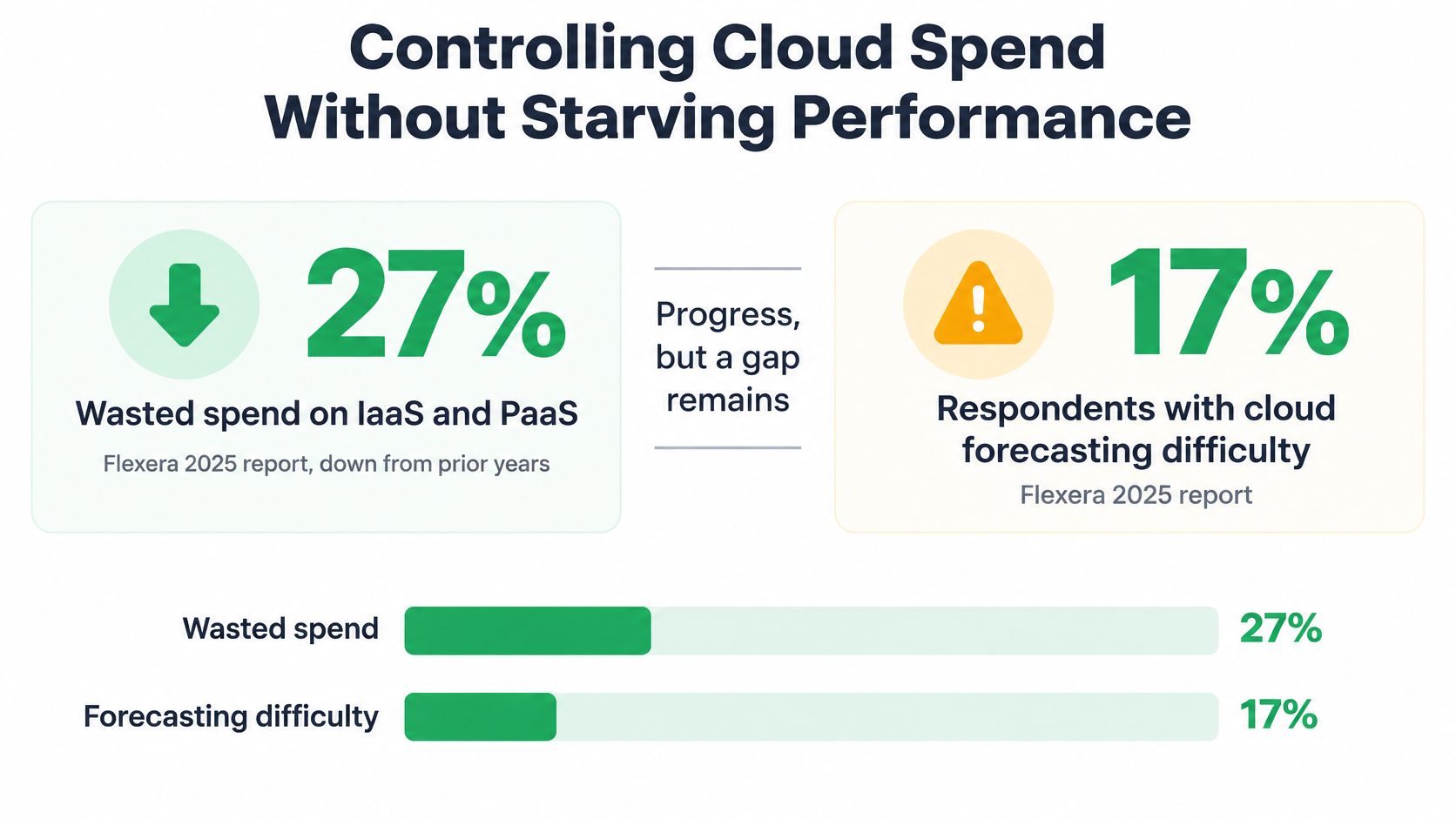
According to Flexera's 2025 State of the Cloud Report, estimated wasted spending on infrastructure as a service and platform as a service had fallen to 27%, yet 17% of respondents still reported difficulty with cloud forecasting and budgeting. Reducing waste and predicting future demand are different jobs.
Extend resource metadata with product ownership, then show each team its allocated spend. Finance owns budget reporting; engineering owns the changes that affect consumption; product owners decide whether the resulting service is worth its cost.
Give cost decisions a review rhythm
Cost and operations review rhythm
| Frequency | Monitoring task | Cost task |
|---|---|---|
| Daily | Triage alerts raised overnight | Check spend anomaly alerts |
| Weekly | Review noisy alerts and incident trends | Review spend by team and tag |
| Monthly | Check capacity headroom on critical services | Right-size idle or oversized resources |
| Quarterly | Update the capacity forecast | Reset budgets and commitment plan |
Use this as a recommended schedule, with an owner and recorded decisions for each review. A dashboard without someone authorized to act is just a more convenient bill.
Start with lower-risk changes:
- Schedule non-production environments: Shut them down outside agreed working periods, preserving exceptions for integration jobs.
- Right-size compute: Inspect peak demand and recovery headroom before reducing resources.
- Commit selectively: Buy usage commitments against stable baseline demand, not an optimistic growth forecast.
- Tier cold data: Check retrieval behavior and recovery requirements before changing storage classes.
- Reduce avoidable transfer: Co-locate chatty services where placement rules allow it, and inspect traffic paths before moving data.
Optimize reliable outcomes for AI
The cheapest architecture isn't necessarily the most economical. Aggressive downsizing or reliance on interruptible capacity can increase retries, latency, and operator workload.
For AI services, allocate shared model costs explicitly and measure cost per successful inference or active user alongside latency and model quality. Include storage, data transfer, and supporting services rather than reporting accelerator spend alone.
Say a team halves its model-serving capacity and discovers during a controlled test that response times double. It restores the previous configuration and records the result. The useful lesson isn't that downsizing always fails, but that savings require a successful workload test.
Set financial and service acceptance criteria together. A lower bill doesn't justify an unusable product.
Choosing Between Single, Hybrid and Multi-Cloud
Placement decisions start with constraints, not a preference for a particular architecture. The Uptime Institute's 2026 Global Data Center Survey reports that 68% of respondents cited data security as a cloud-adoption obstacle, up from 60% in 2024; regulation rose from 44% to 55%.
Distinguish hybrid cloud, which combines cloud and private infrastructure, from multi-cloud, which uses multiple cloud providers. Neither automatically makes workloads portable.
Single-cloud, placement and portability strategies compared
| Strategy | Best when | Main cost | Trigger to choose it |
|---|---|---|---|
| Single-cloud optimization | One provider covers most workloads and the team wants depth | Vendor lock-in and exposure to one provider's outages | No regulatory split and low exit risk |
| Deliberate workload placement | Different workloads need different regions or hardware | More tooling and policy to govern where workloads run | Data residency rules or GPU needs on a second platform |
| True portability | Core services must run on another provider or on premises | Abstraction layers hide differences and add engineering cost | Strict outage-tolerance requirements or proven exit risk |
Define the minimum portable surface
Preserve the parts needed for a credible move: container definitions, versioned infrastructure modules, documented identity mappings, consistent telemetry, and usable data export formats. Portability means maintaining tested equivalents, not assuming identical configuration will run everywhere.
Allow provider-specific optimization outside that boundary when the benefit justifies the exit work. A managed database may reduce operational burden even if replacing it would require application changes.
Kubernetes and infrastructure as code don't resolve differences in networking, identity, accelerator availability, managed-service behavior, or failure modes. Someone must still test the target environment and maintain its recovery procedures.
Portability is valuable when you can demonstrate a move, not merely describe one.
Let workload requirements decide
Consider a healthcare system whose applicable requirements restrict patient records to an approved region. The architecture team must work within that boundary; it can't override it to obtain cheaper capacity. A reporting workload might run elsewhere if its data handling and permissions allow that move.
Galliot's practical hybrid cloud and edge computing example provides context for dividing execution across environments. Keep the operational question explicit: who supports each boundary when connectivity fails?
Write down the triggers for revisiting your choice: regulatory changes, outage tolerance, data-transfer exposure, utilization variability, and exit cost. Review the strategy annually as a recommended governance practice, and sooner when a trigger changes. Don't maintain an unused second platform without a business reason.
Confirm Your Operating Model Before You Change Anything
Before reorganizing tools or moving workloads, establish how the team will operate. Blowfish Technology's explanation of what a target operating model means is useful context for connecting responsibilities, processes, and delivery.
Use this checklist this week:
- Name accountable owners for every row in the ownership table, including backup coverage.
- Schedule the reviews and assign a person to run each meeting and record decisions.
- Control changes through code or a logged exception process, with approval and verification.
- Exercise recovery by writing rollback and failover runbooks, then testing a relevant procedure.
- Verify account custody before giving an outside team production access.
Choose support against the actual duties
Staff these responsibilities internally, add partial engineering support, or engage a managed partner. Compare each option against the same ownership table, not the breadth of its tooling claims.
Galliot is one option. An engagement starts with a call with a Galliot engineer, followed by a review of your infrastructure, pipelines, and cloud bill to agree a short list of fixes. Our cloud computing roadmap can help frame that planning discussion.
Whichever route you choose, retain ownership of the work and make the handoffs explicit. The useful outcome is a team that knows who acts, who approves, and how to recover.
Galliot offers cloud and platform engineering support for infrastructure, deployment pipelines, monitoring, and the systems behind AI workloads. Visit Galliot to arrange an engineering discussion about your current setup and agree which operational fixes to tackle first.
Get Started
Have a question? Send us a message and we will respond as soon as possible.
Leave us a comment